

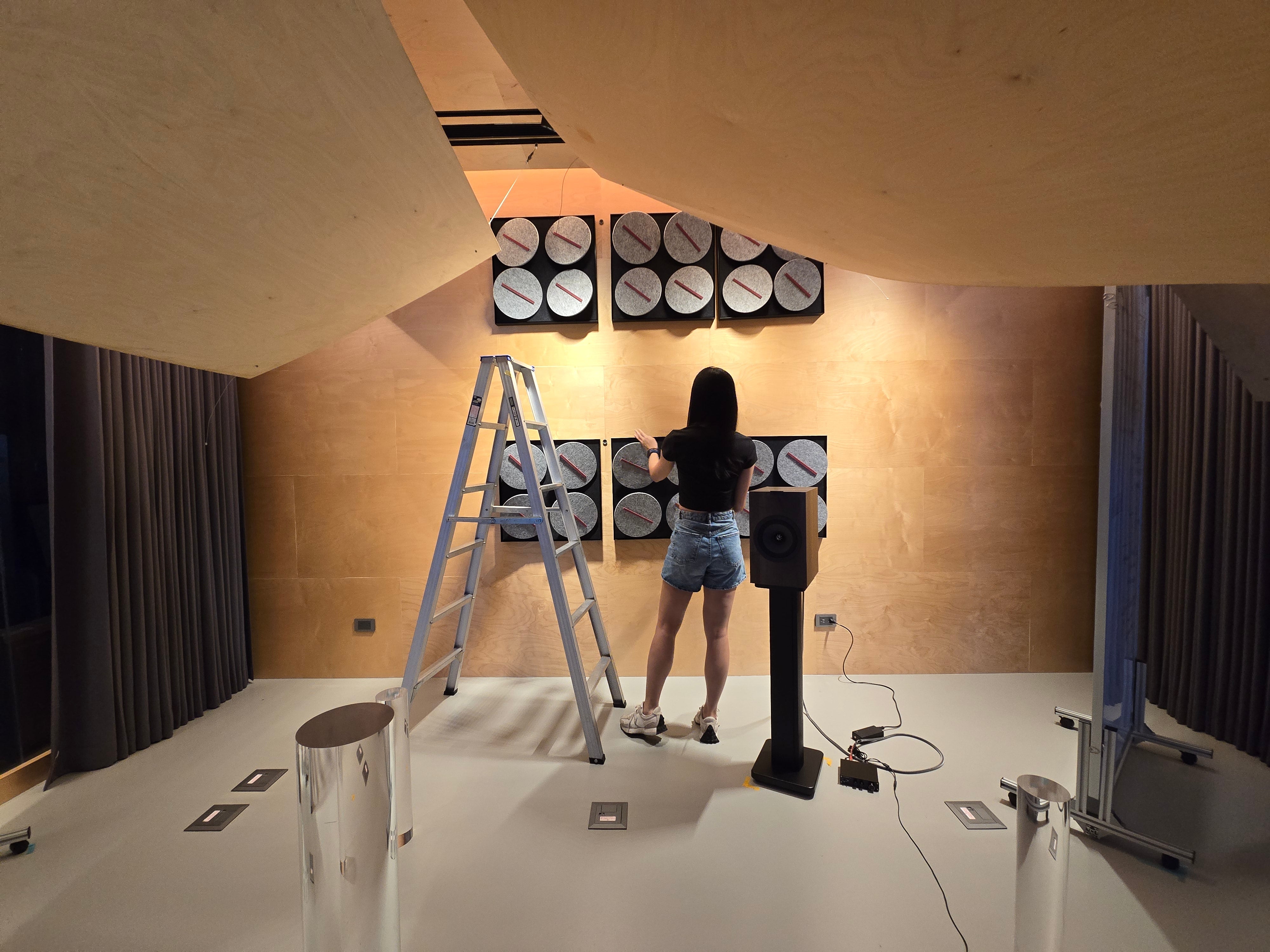
We shaped Cymbals Pro as a wall sculpture in absorbing felt: four tilted discs on every panel, standing out from the wall. Then we measured it, and the result surprised us. So we did what any reasonable manufacturer does with good news. We checked our method against a panel that has a laboratory report.

The measurement itself is simple: six panels on one wall of our studio, a calibrated microphone and REW. The result is NRC 1.35 for Cymbals Pro without Basstrap, and NRC 1.50 with it, the second figure calculated rather than measured. NRC is a single number for each configuration, so those two figures are the whole headline. Single frequency bands read well above 1, which is not the same thing, and we explain why below.
What we tested
- Panels: 6 Cymbals Pro 2'x2', in two rows of three on one wall, with gaps between them: 1.98 m² of wall covered
- Panel size: 575 × 575 mm and 50 mm thick, with the tilted discs reaching up to about 150 mm from the wall
- Mounting: the panel's back flat on the wall, with no spacer and no air gap behind it
- Microphone: UMIK-1, calibrated, with its 90-degree calibration file (microphone pointing up)
- Speaker: KEF Q350
- Amplifier: ICEpower 100AS2
- Software: REW (Room EQ Wizard)
- Room: Massform's studio, 19.6 m² floor, 55.5 m³, with lightweight diffusers and curved wooden ceiling reflectors fitted for the measurement
- Microphone positions: 4, with 5 sweeps at each, averaged: 20 sweeps per condition
How the number is worked out
This is an in-room measurement, not a laboratory test. We measured the room empty and again with the panels, worked out the absorption the panels added from the change in reverberation time (the Sabine equation), and divided it by the wall area the panels cover.
Each band is then corrected by the difference between Surge Pro's result in the laboratory at National Taiwan Ocean University (NTOU, ASTM C423-22) and Surge Pro measured in this same room. It is the same offset we use for Rhythm Pro, printed band by band in the spreadsheet below. It comes from a Surge Pro run that is not among our published files, and the Rhythm Pro write-up compares it with the one that is. Surge Pro's laboratory test is described in full in our lab test write-up.
The correction ties the result to a laboratory reference. It does not make it a laboratory result, and it cannot take out the extra edge of a small sample, which we come to below. So we label it for what it is: Massform office REW measurement, calibrated against Surge.

The result
- Cymbals Pro without Basstrap: NRC 1.35
- Cymbals Pro with Basstrap: NRC 1.50, calculated, not measured
Source: Massform office REW measurement, calibrated against Surge. NRC is the average of the 250, 500, 1000 and 2000 Hz bands, rounded to the nearest 0.05. Before rounding, the averages are 1.335 and 1.4925.
We have not measured Cymbals Pro with a Basstrap. The with-Basstrap figure is the in-room panel curve plus, band by band, the difference a 50 mm Basstrap Pro made to Surge Pro in the NTOU laboratory (reports A-10-2025 and A-11-2025).
Absorption by frequency
| Frequency (Hz) | Cymbals Pro, panel alone (in-room, calibrated) | Cymbals Pro with Basstrap (calculated) |
|---|---|---|
| 125 | 0.22 | 0.39 |
| 250 | 0.88 | 1.47 |
| 500 | 1.61 | 1.65 |
| 1000 | 1.54 | 1.55 |
| 2000 | 1.31 | 1.30 |
| 4000 | 1.41 | 1.49 |
These are the octave centre bands of the published one-third-octave curve. The full curve, 100 Hz to 5 kHz, is on the Cymbals Pro product page as an interactive chart, and every band and microphone position is in the spreadsheet below. If one-third-octave charts are new to you, this guide walks through one.
Why the numbers run above 1
A coefficient is the absorption the panels add, divided by the wall area they cover. A flat panel offers sound little more than its front face. Cymbals Pro offers more, for two reasons:
- More felt in the sound's way: the tilted discs expose their faces, edges and undersides. Measured from our 3D models, they give sound more than three and a half times the felt of a flat fabric-wrapped panel the same size. More felt is not the same as more absorption, though. A flat 50 mm panel already absorbs nearly everything in the highs, so the extra felt adds most in the mids, which is where Cymbals Pro reads highest.
- Edge effects: sound bends round the edge of every disc and every panel and is absorbed there too. Six separate panels with gaps between them have a lot of edge for their size, so a small sample like this one reads higher per square metre than a large, continuous wall of panels would.

So a value above 1 is real. It does not mean the panels absorb more sound than reaches them. It means more sound reaches them than their outline on the wall would suggest. Why an NRC over 1.0 is possible explains the method in more detail.
Where it doesn't work (and why that's fine)
Below 250 Hz, the panel alone adds very little. From 100 to 200 Hz the readings wander between −0.12 and 0.22 with no pattern: in a room this size, the room's own modes swamp what six panels do in those bands. That is expected, not a flaw. A panel this size and depth does little for deep bass, whatever shape it takes. Bass is not impressed by sculpture.
If you are treating a room for music, pair Cymbals Pro with the Basstrap Pro, which goes behind the panel. In the calculated curve it lifts 250 Hz from 0.88 to 1.47, and 200 Hz from nothing measurable to 0.57. Below about 150 Hz, start with where the speakers and the listening seat sit; the bass trap guide covers what a Basstrap can and cannot do.
See for yourself
We publish the raw REW files. If you are an engineer, an audiophile or simply curious, open them in REW and look through the waterfalls, spectrograms and decay curves, or check our arithmetic in the spreadsheet. We would rather you checked our working than took our word for it.
⬇️ Download the data
- Empty room, REW .mdat file
- Cymbals Pro, 6 panels, REW .mdat file
- Google Sheet: Cymbals Pro absorption data, every band and position
- REW software download (free)
We set out to make a wall sculpture in felt. The tilted discs that make it a sculpture are the same discs that put more felt in the sound's way. To estimate what a given number of panels would do in your own room, Hear your room plays the echo with and without them and suggests a count. It is an estimate, not a measurement.



Share:
Beyond the Specs: Why Is NRC Over 1.0 Possible?
Beyond the Specs: What Is an Air Gap, and Why Does It Help?