

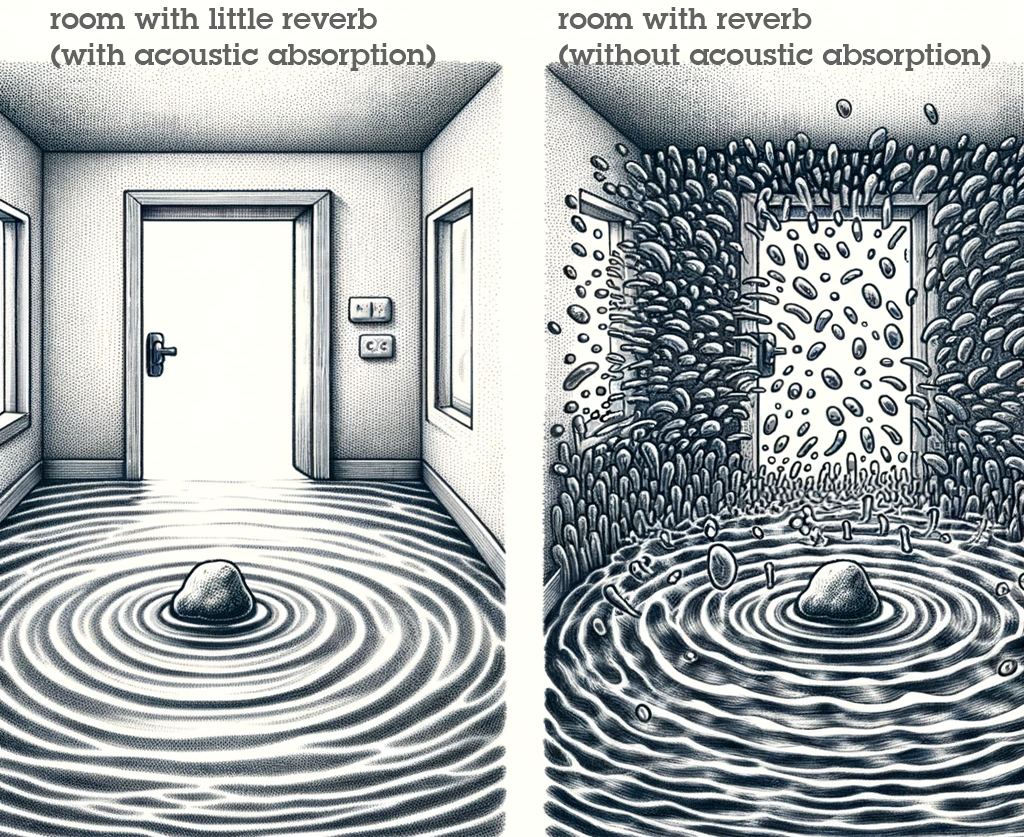
Imagine you're standing by a pond, tossing a stone into the water. The ripples spreading outward are like the sound of your voice or your music. Now imagine those ripples reaching the edges of a small pond and bouncing back, again and again, until the whole surface is busy. That is what happens in a bare room: sound reflects off hard surfaces and keeps going after you stop. That lingering is reverberation, and too much of it makes a room hard to hear in.
How acoustic panels tame reverberation
Acoustic panels are the soft edges of that pond. Instead of returning every ripple, they absorb much of the sound that reaches them, so each reflection comes back weaker and the room falls quiet sooner. What you say stays the same. The room just stops repeating it.

What is reverberation time (RT60)?
Reverberation time, written RT60, is how long a sound takes to fade by 60 decibels after it stops. A drop of 60 decibels leaves a millionth of the sound's energy, so in practice it is the time from a clap to silence.
It is measured in seconds, and it changes with pitch, because every material absorbs some notes better than others. That is why acousticians quote it per octave band, and why the targets below are averages over the middle of the range. Hear your room, our calculator, calls it echo time.
Why reducing reverberation matters
Clearer speech and music
When the tail is long, every word is still ringing when the next one starts. Speech blurs across a dinner table, and in music the room's own ring covers the detail the recording carries. Shorten the tail and each word, and each note, lands on its own.
Calls and meetings
If people on calls keep asking you to repeat yourself, it is probably not your microphone. It is your room. The microphone picks up the room's ring along with your voice, and everyone on the call hears both.
Less noise build-up inside the room
In a busy room, every voice and footstep rings on after it is made, and the tails pile up into a general din. Panels shorten those tails, so less of the noise builds up. They do not stop noise coming in from next door or the street: that is a construction job, explained in absorption vs soundproofing.
What should my room's reverberation time be?
- Meeting rooms and rooms for calls: 0.6 seconds or less. The WELL Building Standard sets this for meeting rooms (WELL v2, feature S04).
- Living rooms: about 0.5 to 0.8 seconds. We know of no standard that sets one for living rooms. This is the range Hear your room suggests.
- Hi-fi listening rooms: about 0.3 to 0.4 seconds. That is where IEC TR 60268-13, whose room for listening tests on loudspeakers is modelled on an average living room, meets the reference listening rooms of EBU Tech 3276, the European Broadcasting Union's specification, at 0.2 to 0.4.
- Studios and control rooms: 0.2 to 0.4 seconds (EBU Tech 3276).
What those numbers sound like: say "check, one, two" in a room at 1.2 seconds and each word is still ringing as the next arrives. At 0.6, every word lands. At 0.3, it sounds close and controlled. Push much further and the room turns dull and boxy, a fine quality in a wardrobe and a poor one in a living room. Aim for balanced, not dead.

How to calculate reverberation time: Eyring in five steps
You can estimate your room's reverberation time with a tape measure and a calculator. The formula is the physicist Carl Eyring's, from 1930, and it needs three numbers: the room's volume, its total surface area, and how much sound it absorbs.
RT60 = 0.049 × V ÷ (-S × ln(1 - A/S))
In feet: V in cubic feet, S in square feet, A in sabins. In metres the constant is 0.161, with V in m³, S in m² and A in m². The example below is the same room in both.
Step 1: the size
Our room is 15 by 12.5 feet, with an 8 foot ceiling (4.6 by 3.8 m, 2.4 m high). Multiply them for the volume: 1,500 cubic feet (42 m³). Add up all six surfaces (floor, ceiling and four walls): 815 square feet (75 m²).
Step 2: the surfaces
Every material absorbs a share of the sound that hits it. That share is its absorption coefficient: 0 for a perfect mirror, 1 for an open window. Multiply each surface by its coefficient to get its absorption, in sabins. One sabin is one square foot of open window; the metric unit is one square metre of it.
Drywall walls and ceiling: 628 square feet at 0.05, about 31 sabins. A hard floor: 188 square feet at 0.06, about 11. The bare room absorbs about 42 sabins (3.9 m²).
Step 3: what's in it
A fabric sofa: about 11 sabins. A thick 8 by 10 foot rug: about 41 more. Heavy curtains: about 14. And one human being, such as yourself: about 5. Furnished, the room absorbs about 113 sabins (10.4 m²).
For rugs and curtains, count what they add over what they cover: a thick rug at about 0.57 lies on a floor that already had 0.06.
| The example room | Feet | Metres |
|---|---|---|
| Size | 15 × 12.5 × 8 ft | 4.6 × 3.8 × 2.4 m |
| Volume, V | 1,500 ft³ | 42 m³ |
| Surface, S | 815 ft² | 75 m² |
| Drywall walls and ceiling, at 0.05 | 628 ft²: about 31 sabins | 58 m²: about 2.9 m² |
| Hard floor, at 0.06 | 188 ft²: about 11 sabins | 17.5 m²: about 1.0 m² |
| Bare room, A | about 42 sabins | about 3.9 m² |
| Fabric sofa | about 11 | about 1.0 |
| Thick rug, 8 × 10 ft (2.4 × 3 m) | about 41 | about 3.7 |
| Heavy curtains | about 14 | about 1.4 |
| One person | about 5 | about 0.4 |
| Furnished room, A | about 113 sabins | about 10.4 m² |
Ballpark figures for your own room. Typical values at 500 Hz, rounded. Real items vary, and the bed is a rough guess: there is no standard figure for one.
| Item | Sabins | m² |
|---|---|---|
| A person | about 5 | about 0.4 |
| Upholstered chair | about 2 | about 0.2 |
| Fabric sofa, 3 seats | about 11 | about 1.0 |
| Bed with a duvet (rough guess) | about 10 | about 1 |
| Thick rug, 5 × 8 ft (1.5 × 2.4 m) | about 20 | about 1.8 |
| Thick rug, 8 × 10 ft (2.4 × 3 m) | about 41 | about 3.7 |
| Heavy curtains, 4 × 8 ft (3 m²) | about 14 | about 1.4 |
| Hard furniture: tables, shelves, cabinets | close to 0 | close to 0 |
Step 4: the formula
First, the room's average share: the absorption divided by the surface. For the furnished room, 113 ÷ 815 = 0.139. Then work through the formula from the inside out: 1 - 0.139 = 0.861; ln(0.861) = -0.150; times 815 is -122, and the minus sign in front of S turns it into 122. On top, 0.049 × 1,500 = 73.5. And 73.5 ÷ 122 = 0.60 seconds.
The only odd key is ln, the natural logarithm. Your phone's calculator has it in scientific mode. The bare room comes out at 1.7 seconds; furnished, 0.6.
You may have seen the simpler Sabine formula, RT60 = 0.049 × V ÷ A. It is fine for bare rooms, but it overstates once a room is treated: for the furnished room it says 0.65 seconds, 8% too long, and the gap grows as you add panels.
Step 5: the target
For a hi-fi room, what does 0.4 seconds need? Turned round, the formula asks for about 165 sabins: 52 more than the furnished room has. A 2 by 2 foot felt panel with an absorption coefficient of about 0.9 at mid frequencies, hung over drywall at 0.05, adds 4 square feet × 0.85, about 3.4 sabins. So about 16 panels get you there.
In metres: about 15.1 m² needed, 4.7 more. A 60 by 60 cm panel adds about 0.31 m². Again about 16 panels.

What the five steps leave out. This is one number for the middle of the range. It assumes the absorption is spread evenly around the room, which a rug and a wall of panels are not, and it says nothing about the bass, where a felt panel absorbs much less. A real calculation runs per octave band, with each panel's published values. Surge Pro, for example, carries NRC 0.95 without a Basstrap and 1.15 with one, from National Taiwan Ocean University's tests to ASTM C423-22. Wave publishes the same pair.
A reverberation time calculator: Hear your room
Hear your room is a free RT60 calculator that does the five steps for you, octave by octave, with Eyring's formula and the air's own absorption. Enter your room's size, floor, walls, ceiling, glass, people and soft chairs, choose panels, and it plays a voice through the room as it is and with them, so you hear the difference before you buy anything. It can also suggest how many panels a room needs.
Its example living room, 5 by 4 m (16 by 13 ft) with a 2.7 m (9 ft) ceiling, a wood floor, plasterboard walls and ceiling and 3 m² (32 sq ft) of glass, rings for about 1.70 seconds across the voice range (500 Hz to 2 kHz) by the page's estimate, against the 0.5 to 0.8 seconds it suggests for a living room.
Every figure on the page is an estimate, not a measurement. We checked it against our own 55.5 m³ studio: starting from the empty room's measured reverberation, adding 8 Surge Pro 2'x4' panels (5.4 m² of panel face) predicted the measured treated room within 8% in every octave from 250 Hz to 4 kHz. Another room can be further out, and the page marks the bass bands as indicative.

Like the five steps, Hear your room assumes the absorption is spread evenly, so it cannot say where panels should hang. Plan in 3D places them on your own walls, around your furniture, doors and windows. It gives an estimate too, not a measurement.
If you would rather not do sums at all, send a photo of your room to the Massform concierge, an automated acoustics concierge trained by the Massform team, and ask.
Measure it properly
A clap tells you a room echoes. Clap once: a fast, metallic zing afterwards is flutter echo, sound bouncing between two bare, parallel surfaces. But a clap can't tell you which notes ring, or for how long. For that, you measure, and the kit is modest:
- A computer (Mac, Windows or Linux) running Room EQ Wizard, or REW, which is free.
- The speaker you normally listen on.
- A measurement microphone on a stand. The simplest kind plugs straight into USB.
Not your phone, and not your laptop's own microphone. Those are built for calls: they turn themselves up and scrub out noise while they listen, which distorts the very fade you want to measure. A measurement mic just listens.
A calibration file is optional for decay times. Some measurement mics come with one. It corrects that mic's own tone by a few decibels, mostly in the treble, so if yours has one, load it. If it doesn't, measure anyway: REW works out decay times without it and uses it only to correct the frequency graph. We tried it on our own studio recordings, giving all 60 published sweeps a badly-off mic's tone, up to 8 dB too loud in the treble. The octave-band decay times moved by under 2% on average, and 3.2% at worst. And when you compare before and after with the same mic, its tone cancels out.
The routine: put the mic where you sit to listen, at ear height, on its stand, pointing straight up at the ceiling. Air conditioning off, windows shut. In REW's Preferences, choose your speaker as the output and the mic as the input. Then open Measure, press Check Levels and bring the speaker up to about your normal listening level. Sweep from 20 Hz to 20,000 Hz, press Start and stay still. Then open the RT60 tab, choose octave bands and follow the T20 line. Treat the room, and measure again: same mic, same spot, same volume.
T20, T30 and RT60
Few rooms are quiet enough to watch a sound fall a full 60 dB, so measurement software times part of the fall and scales it up. T20 times the fall from 5 to 25 dB below the start, T30 from 5 to 35 dB. Both are estimates of RT60.
A note on Massform's own numbers: the "RT60" columns in our published in-room test sheets are T30, per third-octave band. When we say how much a treatment shortened a room's decay, we quote octave-band T20, averaged over the mic positions, with the panel count, the panel area and the room.
For example, in our 19.6 m² (211 sq ft), 55.5 m³ studio, eight Rhythm Pro 2'x4' panels on one wall, 5.4 m² (58 sq ft) of panel face or about a tenth of the wall area, took T20 at 1 kHz from 0.53 to 0.39 seconds, about a quarter shorter. Across four mic positions and 20 sweeps it fell 25 to 27% from 1 to 8 kHz, 18% at 500 Hz, 9% at 250 Hz and 3% at 125 Hz. The in-room test publishes the measurement files.

The bass is a separate job. That 3% at 125 Hz is what panel face does in the bass. By our estimate, not a measurement, halving the decay at 250 Hz in that room would take about 84 of those panels, which is more panel than the room has wall. Depth does more. A Basstrap Pro behind a panel takes its absorption lower, and corners are where bass builds up most. The art of trapping bass covers where they go.



Share:
Understanding Acoustics: Absorption vs. Soundproofing
Finding Harmony: Sound Absorption and Sound Diffusion