

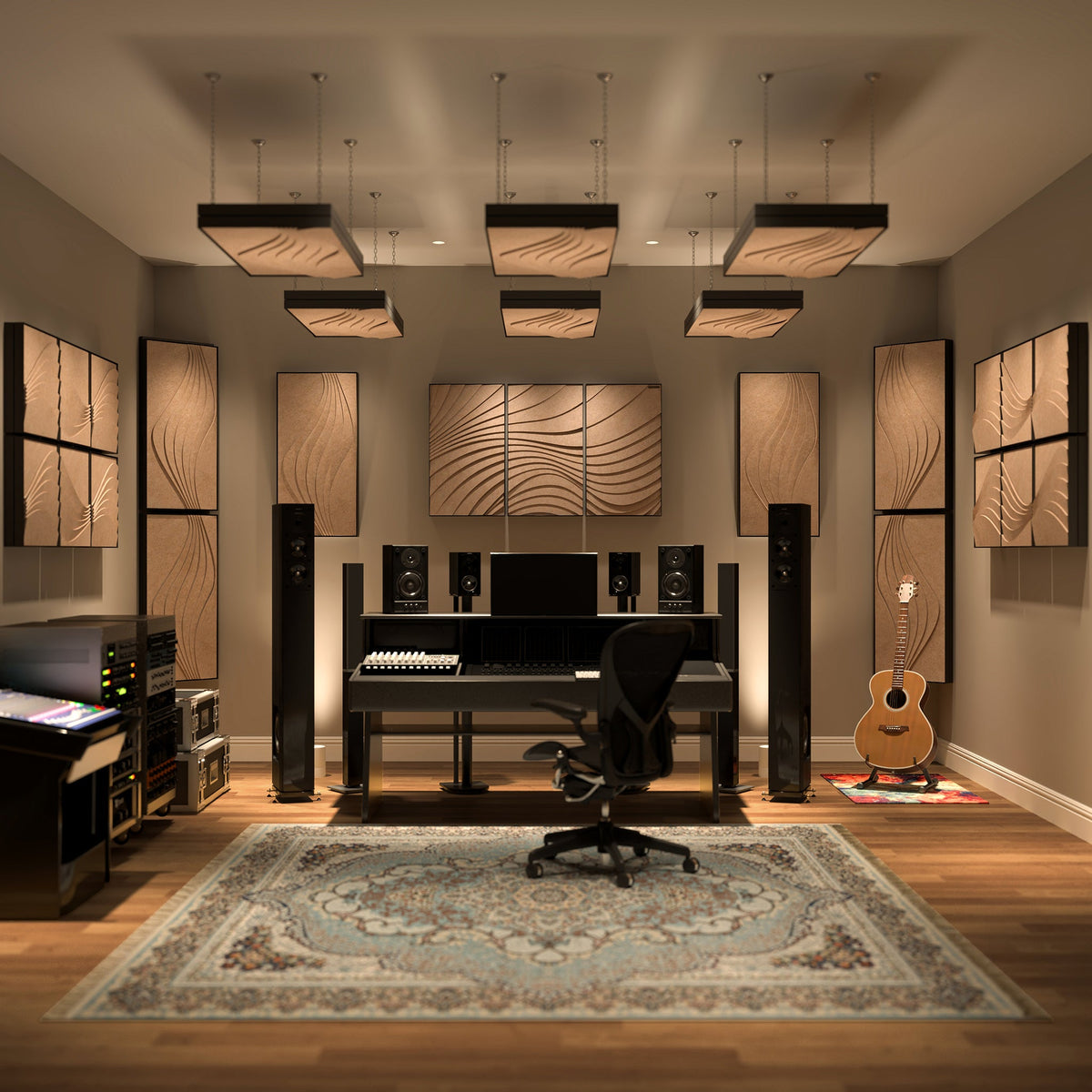
Absorption ≠ Soundproofing
Why the echo goes, but your neighbour's dog doesn't
Do acoustic panels block noise from the neighbours, or from the street? Honest answer: no. But they help, just not in the way the word "soundproof" suggests.
People often mix up sound absorption with soundproofing. We get it: both involve sound, walls and a wish for peace and quiet. But they are two different jobs, and each is rated with its own number.
- Blocking (soundproofing) keeps sound out of your room, or in it. It is rated as sound insulation, in decibels: STC in North America, Rw in Europe.
- Absorbing stops sound bouncing around inside your room. It is rated by the absorption coefficient, the share of the sound reaching a surface that it does not send back, and by NRC, its average at four bands from 250 to 2,000 Hz.
Acoustic panels do the second job. Massform publishes absorption figures for its panels, never an STC, because a felt panel was never meant to stop sound passing through a wall. Surge Pro, for example, reads NRC 0.95 without Basstrap and 1.15 with Basstrap (NTOU, ASTM C423-22). Those are strong numbers for absorbing (why an NRC can go above 1). They say nothing at all about blocking.
Sound Absorption: Softens the Inside
Imagine sound as water. Absorption is like placing sponges around the room. The water still arrives, but it gets soaked up instead of sloshing back and forth. Felt is full of tiny air paths. Sound pushes air into them, the air rubs against the fibres, and that friction turns the sound into a very small amount of heat.

That's what acoustic panels do. They cut echo, soften reflections and stop sound building up, so a room sounds clearer and more settled. It's about what stays in the room and how it behaves.
Think of clapping your hands in an empty gallery, then in a forest. Absorption turns the harsh bounce into a soft hush.

Soundproofing: Keeps Sound Out (or In)
Soundproofing is about barriers: stopping sound from getting into or out of a space. To get through a wall, sound has to shake the whole wall. A heavy, airtight wall barely moves, so most of the sound bounces back on its own side. That means heavy, mass-loaded walls, sealed doors and floating floors. It's not what acoustic panels are made for.
You could cover your studio in felt panels and still hear the scooter outside. Panels are designed to tune a room from within, not to shield it from without.

What actually stops noise
- Seal the gaps. Sound leaks through any opening, the way water does: under and around doors, around windows, through vents, pipe holes and sockets. A door seal and a drop-down threshold seal are the cheapest place to start.
- Add mass. A heavier wall is harder for sound to shake. In theory, doubling a wall's weight lets about 6 dB less through (the mass law), but only while the wall stays airtight. In practice that means extra layers of dense board, or mass-loaded vinyl.
- Decouple. Build the new layer so it does not touch the old one directly, on separate studs or resilient mounts, with fibrous insulation in the cavity between them. Sound then has to cross two separate layers instead of shaking one.
Why the gaps come first, as a calculation. A wall that blocks 50 dB lets through one part in 100,000 of the sound energy that reaches it. Now leave 1% of that wall open. The 1% lets everything through:
0.99 × 0.00001 + 0.01 × 1 ≈ 0.01, about one part in 100
10 × log10(100) = 20 dB
A 1% gap turns a 50 dB wall into about a 20 dB wall. The other 99% of the wall is still doing excellent work. It just no longer matters.
Adding mass and decoupling are construction. The materials are dense, heavy and not cheap, and done properly it's a job for professionals: an acoustic consultant can specify a build for your wall. Can't rebuild? Seal the gaps around your door and windows, then absorb the rest.
Footsteps Upstairs, in a Concrete Flat
Concrete is heavy, and weight is the main thing a wall or floor needs to block sound. So in a concrete flat, the noise that still reaches you often takes another route: through the gaps, or through the structure itself.
Footsteps take the second route. A heel strikes the slab, the slab carries the vibration, and your ceiling plays it into your room as a low thud. Bass from next door's speakers shakes the building too: low notes move even a heavy wall far more easily than high ones.
Felt barely touches either. Both sit low, and low is where felt is weakest. In the laboratory, a Surge Pro panel on its own absorbs 0.08 at 125 Hz, about 8% of the sound that reaches it (NTOU, ASTM C423-22, report A-10-2025). Stacked on a Basstrap Pro it reads 0.25 at 125 Hz (report A-11-2025): better, and still not a fix. And absorbing the thud inside your room does not stop the slab from making it.

What helps is where the foot lands. A thick rug on a good underlay upstairs softens each step before it reaches the slab. On your side, a ceiling hung on its own resilient mounts, decoupled from the slab, can help too, and is construction again. The most effective footstep treatment is in the flat upstairs, and it begins with a polite conversation. No panel can have that conversation for you.
What About Foam?
"Foam" covers two different materials, and they behave differently.
Open-cell acoustic foam is an absorber, like felt: air gets into it, rubs against it, and the sound turns to heat. It does the absorbing job, not the blocking one.
Closed-cell foam, the kind with sealed bubbles used for packing and floor mats, does neither. Its bubbles are sealed, so air cannot get in to rub against anything, and it is so light that sound simply shakes it along. It doesn't block, and it barely absorbs.
A useful rule: if you can hang it on a wall with one hand, it will not block sound. At best, it absorbs. That includes every panel we make.
What Panels Do Solve
Not everyone can live in silence. Cities hum, neighbours walk heavy, and life leaks in through windows, vents and thin walls. When you can't stop it at the wall, you can still change what happens to it once it is inside.
Noise that gets in bounces off your bare walls and builds up, like an amplifier. Absorb those bounces, and the build-up drops.

How much? Take a room of 1,500 cubic feet (15 × 12.5 ft, with an 8 ft ceiling), drywall and a hard floor. Add an 8 × 10 ft rug and 16 Surge Pro 2' × 2' panels, about 15% of the walls. The noise that gets in builds up about 5 dB less: about two thirds less sound energy. You will hear the difference, but it is not half as loud. Heard loudness halves at about 10 dB.
Built-up noise follows L2 = L1 − R + 10 log10(S/A) (ISO 16283-1), so adding absorption lowers it by 10 log10(A2/A1). Bare room: A1 ≈ 3.9 m². With the rug and panels: A2 ≈ 12.6 m². 10 × log10(12.6 / 3.9) ≈ 5.1 dB. Estimate; Massform panels taken as α ≈ 0.9 at mid frequencies.
That figure is for the mid frequencies, not for the bass. The noise is still there. Your room just stops amplifying it, and the ring goes with it.
The same absorption works on the sound you make yourself. Conversations stay at the table instead of filling the room, dialogue on the television is easier to follow, and music comes through with less of the room's ring on top.

To hear what this does in a room like yours, Hear your room estimates the echo with and without panels and plays you both. It is an estimate, not a measurement. For what panels did in a measured room, see do acoustic panels work?, and for why echo matters at all, what reverb is.
Why We Focus on Absorption
Massform makes acoustic panels for people who care how a room sounds and how it looks. Musicians. Designers. Listeners. People who want clarity and beauty in the same space.

The panels shape how sound behaves inside a room: how much of it bounces back, how long it lingers, how it fades.
Not how it stays out. That's a different craft.
So if you're struggling with echo, muddiness or harshness inside your space, panels can help.
If you're trying to block out construction noise or a neighbour's karaoke session, you need something heavier, and probably a builder.
Which Problem Do You Have?
- The noise comes from outside, or from next door: that's blocking. Seal the gaps first.
- Your own voices, television or music sound harsh, echoey or loud: that's absorbing. This is what panels are for.
- Both: block first, then absorb.
Not sure? Send a photo of your room to the Massform concierge, an automated acoustics concierge trained by the Massform team. One of its starter questions is "Will panels block noise from next door?", and it gives the same honest answer.
Blocking keeps noise out. Absorbing stops it ringing.
Want to reshape how your room sounds without building a bunker?
Browse every Massform panel, or start with Surge Pro 2' × 2'. No renovation required.



Share:
Taming Reverb: The Magic of Acoustic Panels