

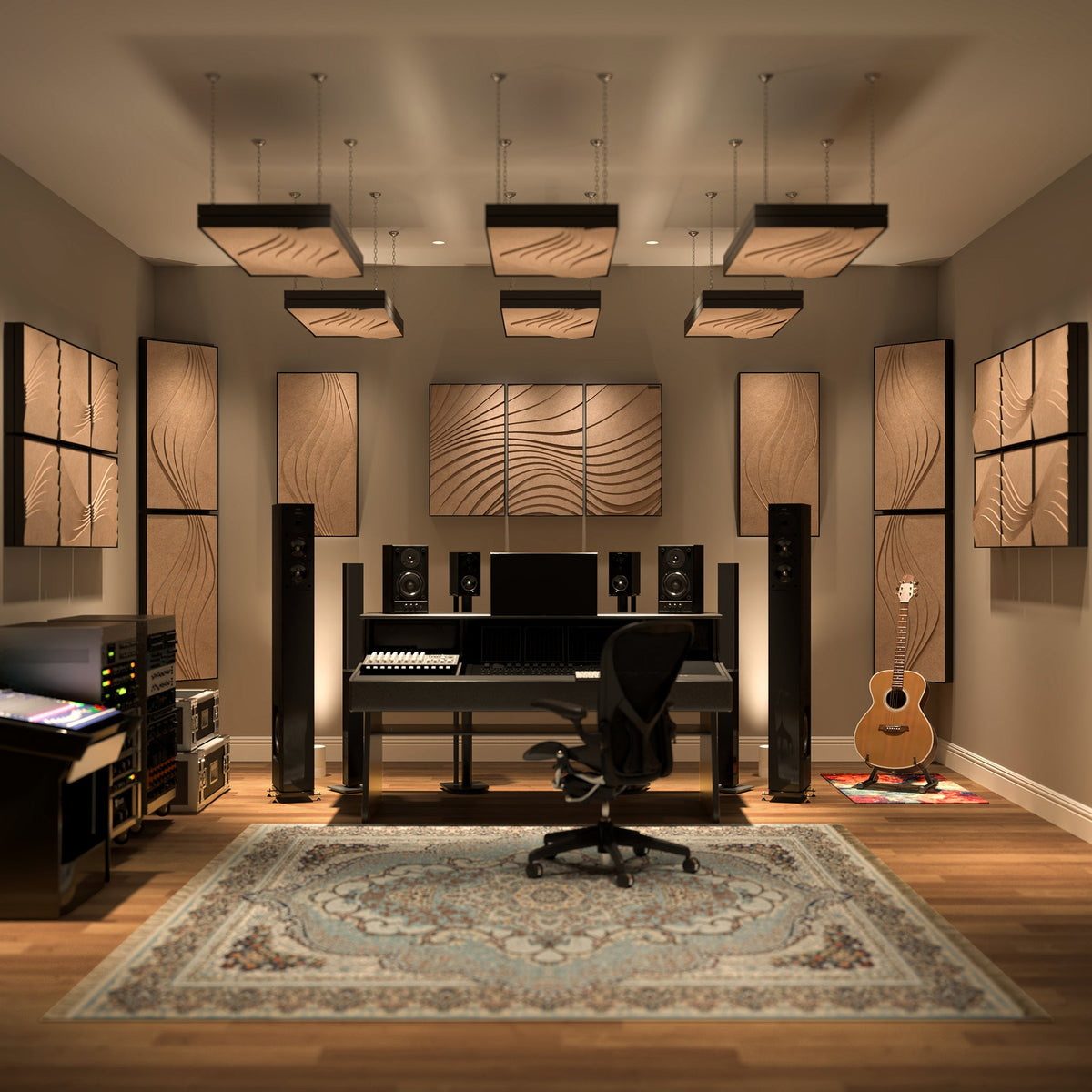
An acoustic panel should be thick enough for the lowest notes you care about, and no thicker. A 50 mm (2 in) felt panel with a little air behind it handles voices, violins and most of the midrange. Doubling the depth to 100 mm (4 in) brings strong absorption down to about 160 Hz. At 125 Hz, even that absorbs only a quarter of the sound, and the deepest bass becomes a job for placement, EQ or a subwoofer. So is thicker always better? Yes, and no.
Is a thicker acoustic panel always better?
Yes, because depth is what lets a panel reach lower notes. Felt absorbs sound by slowing moving air and turning that motion into a little heat. At a hard wall the air barely moves; it moves most a quarter of a wavelength out, and low notes have long waves. At 80 Hz, one wave is over 4 metres long. Felt starts working well before a quarter wave fits inside it, but the rule holds: the deeper it sits, the lower it reaches.

No, because depth costs space and money, and there is a floor it never gets through. Nothing on a wall gets near 20 Hz. That wave is 17 metres long, and the air it moves hardest sits about 4.3 metres from the wall. A panel built to meet it would be less a wall panel than a house extension.
Ask a forum and the usual answer is four to six inches. For a bass-first studio, that is good advice. For a living room, which people also have to live in, it can be more panel than the music needs.

How deep should acoustic panels be? Count the air behind them
Depth means the felt plus the air behind it. Move a panel off the wall and the same felt sits where the air moves more for lower notes. The gap weighs nothing, but it adds no felt either. A quarter wave is about 17 cm (7 in) at 500 Hz and 34 cm (13.5 in) at 250 Hz, so a few centimetres of gap helps a band of lower notes, not the whole low end. What an air gap is, and why it helps covers the physics. It also means a thickness on a spec sheet says little without its mounting.

Acoustic panel thickness and frequency: what the laboratory measured
The laboratory measured the same panels both ways. Nineteen panels of the construction Surge Pro and Wave share, 50 mm thick, were raised 35 mm off the test surface, the same gap as the spacer Surge Pro comes with. Then each was stacked on a 50 mm Basstrap Pro of the same size: 100 mm on the same raise. Both are ASTM C423-22 tests at National Taiwan Ocean University (reports A-10-2025 and A-11-2025). A coefficient of 0.59 means about 59% of the sound reaching the panel is absorbed; values over 1.0 come from sound bending round the edges.
- 50 mm on its gap: 0.21 at 160 Hz, 0.31 at 200 Hz, 0.59 at 250 Hz, 0.95 at 400 Hz, and 1.0 or more from 500 Hz to 2.5 kHz.
- 100 mm, with the Basstrap behind it: 0.83 at 160 Hz, 1.00 at 200 Hz, 1.18 at 250 Hz.
- At 125 Hz: 0.08 for 50 mm, and 0.25 for 100 mm.
Doubling the depth roughly quadrupled the absorption at 160 Hz and moved full absorption from 500 Hz down to 200 Hz. At 125 Hz it still caught only a quarter. That is the yes and the no, measured. It is also why NRC says little about thickness: it averages four bands, 250, 500, 1000 and 2000 Hz, so 160 and 200 Hz, where these two builds differ most, never enter it. Behind the numbers explains the test.

What is your music made of?
Every note is a stack of frequencies: the fundamental sets the pitch, and harmonics sit above it at two, three and four times that frequency. The lowest notes of some familiar instruments:
- Violin: 196 Hz
- Guitar: 82 Hz
- Cello: 65 Hz
- Bass guitar: 41 Hz
- Piano: 27.5 Hz
A voice sits mostly in the midrange, and the detail that makes words clear sits higher. For voices, violins and conversation over dinner, 50 mm on a gap covers most of it.
The lowest notes of the cello, piano and bass guitar sit below where panels do much, but their harmonics land higher. A cello's lowest C, at 65 Hz, has harmonics at about 131, 196 and 262 Hz, and the upper two fall in bands where the Basstrap's extra 50 mm at least doubled the absorption in the lab. If the music you love is built on a bass line, that is where depth earns its place.

Acoustic panel thickness for a home theatre
Dialogue is midrange, and 50 mm on a gap handles it well. A subwoofer plays lower than any panel reaches, so its position and room correction decide how even the bass is. Add depth where the low notes build up, usually near the corners, and leave the lowest notes to placement.
Acoustic panel density: can heavier felt replace depth?
Not really. A porous absorber comes down to thickness, density and flow resistivity, and density is the one people quote. Massform's polyester (PET) felt is on record at 207 to 226 kg/m³ across three sources. By their makers' data sheets, that is more than three times a common mineral-wool board (64 kg/m³) and more than four times a common glass-fibre board (48 kg/m³). It is still not a score. A denser board does not move the quarter wave any closer to the wall.
What the dense felt does give is a material built to hold its shape, so it can be sculpted and left without a fabric cover. Sculpting puts more felt in the sound's way: Rhythm Pro's slats stand out from the wall, so sound reaches both sides of every slat, more than four times the felt of a flat fabric-wrapped panel the same size (measured from our 3D models). Surface is not absorption, though. It helps most in the mids. Bass still needs depth.

Flow resistivity is how hard it is to push air through the material: too open and sound passes straight through, too tight and it bounces off the face. We have not measured ours yet, so there is no number for it here.
Thin felt tiles or deep felt panels?
Both are felt, so the difference is construction. A thin tile glued flat to a wall sits where only the higher notes move the air much. It takes the edge off clatter and slap echo, often all a hallway or an office needs, and on battens with a cavity behind it, it reaches lower. A deep panel builds the depth in: thicker felt, a form that holds it out from the wall, a mounting gap, and in Massform's case the option of a Basstrap behind. For clatter, thin may be enough. For music, go deeper.

What panels cannot do, and what we have not measured
- The deepest bass. At 100 and 125 Hz, the lowest bands the lab measured, even the 100 mm build absorbs only about a quarter. Down there the room's dimensions decide where notes boom and vanish, so move the speakers and your seat first, then use EQ or a well-placed subwoofer.
- Soundproofing. Panels absorb sound inside the room. They do not stop it reaching the neighbours.
- Untested setups. The laboratory figures cover a 35 mm gap, with and without one Basstrap. Panels flat on the wall without the spacer, ceiling clouds, corner mounts and a second Basstrap have no test of their own, and the felt's flow resistivity is unmeasured.
Hear your room lets you put Surge Pro on your walls, with or without a Basstrap behind it, and play a voice through the room as it is now and with the panels. It gives an estimate, not a measurement, worked out from your room's size and surfaces, and it marks its lowest bands as indicative.
Frequently asked questions
Are 2 inch acoustic panels enough?
For voices and most of the midrange, yes, with a little air behind them. In the lab, 50 mm (2 in) Surge Pro panels on a 35 mm gap absorbed 0.95 at 400 Hz and 1.0 or more from 500 Hz to 2.5 kHz. For music with a lot going on below 250 Hz, add depth.
2 inch vs 4 inch acoustic panels: what is the difference?
Mostly the band from about 160 to 400 Hz. Going from 50 to 100 mm on the same gap took absorption at 160 Hz from 0.21 to 0.83, and at 200 Hz from 0.31 to 1.00. From 500 Hz up, the two read much the same.
How thick are acoustic panels in mm?
It depends on the type. Common foam and fibre boards come in thicknesses such as 25 and 50 mm (1 and 2 in), and felt tiles are usually thinner. Surge Pro 2′ × 4′ is built on a 50 mm frame, with its sculpted felt rising to 60 mm, and the 35 mm spacer it comes with sets it off the wall. A Basstrap behind it adds another 50 mm.
How big should acoustic panels be?
Size and thickness do different jobs. Thickness sets how low a panel reaches; size and count set how much of the room's sound it catches. How many acoustic panels do I need works out the count for your room.
Thick enough for your music. Not thicker.



Share:
The Partner Acceptance Factor: Acoustic Panels the Whole Household Agrees To
Where to Put Acoustic Panels, and How to Lay Out the Wall