

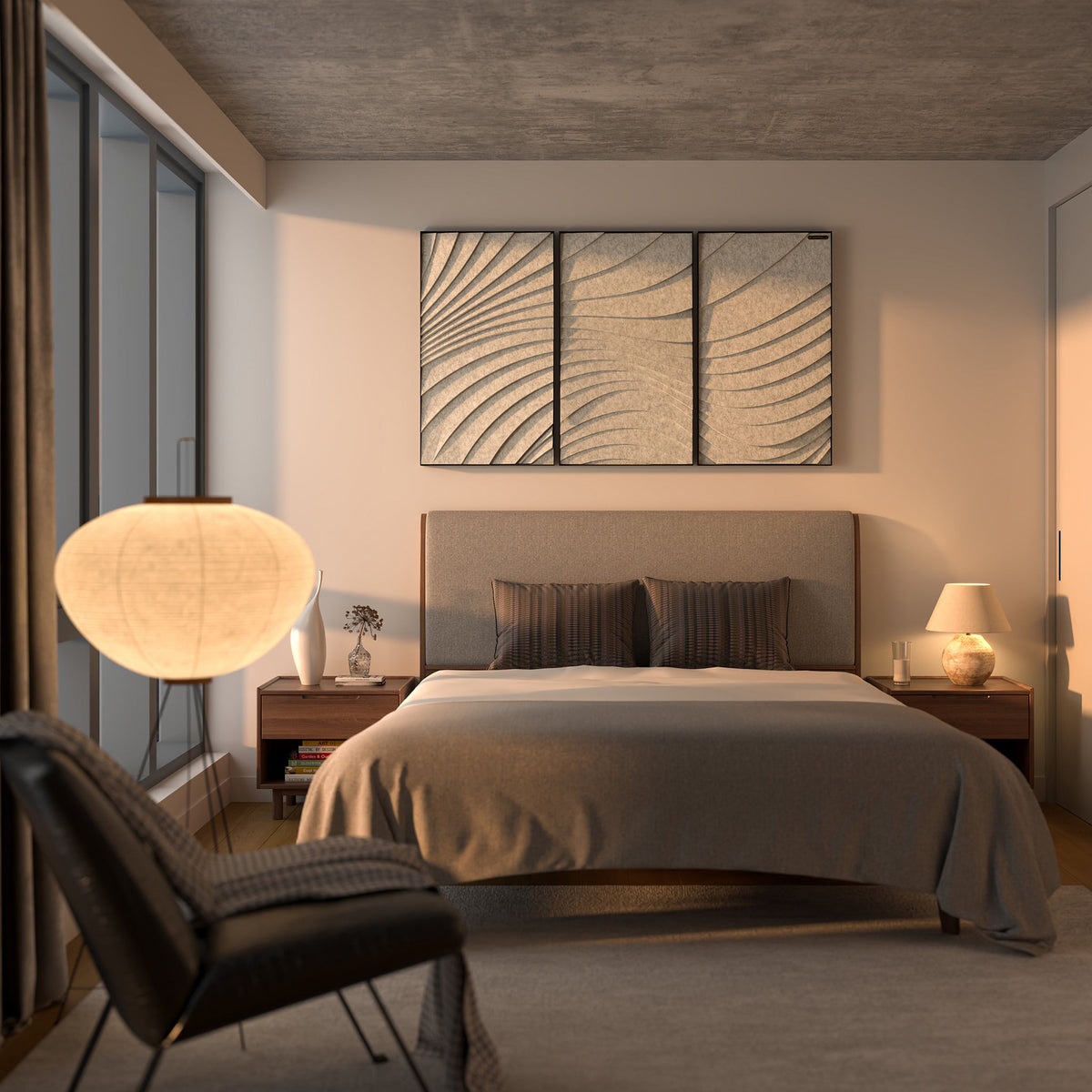
You need enough panels to bring the echo into the right range for how you use the room, and that depends on how much the room already absorbs. By our estimate, in a bare room with plasterboard walls and a hard floor, panels on about a tenth of the walls roughly halve the echo. A furnished room starts closer to the right range, so it needs fewer. For your own room, Hear your room gives a count in a couple of minutes and lets you hear the room now and with the panels, before you buy any.
Why the rules of thumb for acoustic panels disagree
Search the question and you will be told anything from 10 to 40% of the walls, 40% of the floor, or a count in sabins, the unit of absorption. Everyone is right, about a different room.
How long a room echoes depends on its volume and on everything in it that absorbs, from the walls to the sofa and the people. Each panel adds a roughly fixed amount, and making the echo a given fraction shorter takes absorption in proportion to what is already there. So the same panels do much more in a bare room than in a furnished one. A coverage percentage does not travel from one room to the next.
Two rules for how much acoustic treatment you need
Rule one: treat at least one side of every facing pair. Clap once in an empty room. That zing is sound bouncing between bare surfaces that face each other, wall to wall and floor to ceiling. Panels on one wall of each pair stop the side-to-side bounce. A thick rug, or panels hung from the ceiling as clouds, stops the up-and-down one. You need both.

Rule two: in a bare room, every tenth of the walls you cover adds about as much absorption as the whole room had. So in a bare room, panels on 10% of the walls make the echo about half as long, on 20% about a third, and on 30% about a quarter. A thick 8 x 10 ft rug counts as about another tenth. Each step takes off less time than the one before it.
Estimate; Massform panels taken as α ≈ 0.9 at mid frequencies.

How many acoustic panels for a 1,500 cubic foot room
Take a room 15 by 12.5 ft with an 8 ft ceiling (4.6 x 3.8 m, 2.4 m high), about 1,500 cubic feet: plasterboard walls and ceiling, a wood floor, no glass, nobody in it. Entered in Hear your room, it rings for 1.55 seconds across the speech band (500 Hz to 2 kHz). Worked by hand from single typical values, as in how to calculate reverberation time, the same room comes out at about 1.7 s; the page works octave by octave, with its own values for each surface. With Rhythm Pro 2'x2' panels, the page gives:
- 12 panels (43 sq ft of panel face, 10% of the walls): 0.79 s, about half. This is the page's suggestion for a living room.
- 20 panels (16% of the walls): 0.60 s, its suggestion for an office or meeting room.
- 24 panels (19% of the walls): 0.53 s, about a third.
- 36 panels (29% of the walls): 0.39 s, about a quarter, inside the 0.3 to 0.4 s hi-fi listening rooms aim for.

These are the page's estimates, not measurements, and they follow rule two closely. Few rooms are empty, though. One sabin is the absorption of a square foot of open window, and one seated person absorbs about five. On the page, ten seated guests take this room to 0.71 s, slightly better than a dozen panels. The panels stay after the guests go home.
What 8 acoustic panels did in a measured room
A rule of thumb is an estimate, so we measured a real room. Massform's studio has 19.6 m² of floor (about 211 sq ft) and 55.5 m³ of air. We hung 8 Rhythm Pro 2'x4' panels on one wall: 5.4 m² of panel face (about 58 sq ft), about a tenth of the wall area. We measured with REW (Room EQ Wizard) at four microphone positions, 20 sweeps for each condition.

At 1 kHz the reverberation time (T20) fell from 0.53 s to 0.39 s, about a quarter shorter. From 1 to 8 kHz it fell by 25 to 27%, at 500 Hz by 18%, at 250 Hz by 9% and at 125 Hz by 3%. The setup photos and the raw REW files are in the Rhythm Pro in-room test.
By rule two, a tenth of the walls halves the echo in a bare room. Here it took a quarter off, because the studio started at about half a second and already absorbed a fair amount. By our estimate from that run, not a measurement, halving it at 1 to 2 kHz would take about 23 or 24 of the same panels, about 30% of the walls: three times the panels for twice the effect. At 500 Hz it would take about 36, about half the walls. At 250 Hz and below it would take more panels than the walls can hold. The estimate uses Sabine's formula, which is rough in a small, lively room: read these as an order of magnitude.
We also use this room to check Hear your room. Starting from the empty studio's measured echo, its calculation with 8 Surge Pro 2'x4' panels at their laboratory values came within 8% of the measured result in every octave from 250 Hz to 4 kHz. In another room it can be further out, and the page marks the bass bands as indicative.
Can you have too many acoustic panels?
Yes. Panels work mostly in the mids and highs. Keep adding them and the room goes dull and boxy while the bass still rings, as the studio's 3% at 125 Hz suggests. So choose a target and stop when you reach it:
- Meeting rooms: 0.6 s or less (WELL v2, feature S04).
- Hi-fi listening rooms: about 0.3 to 0.4 s, where IEC TR 60268-13 and EBU Tech 3276 overlap.
- Studio control rooms: 0.2 to 0.4 s (EBU Tech 3276).
Hear your room tells you when the panels cover more than half the walls. Past half the walls, the room starts to sound dead. If the low end still rings by then, more panel face is the wrong tool. Add depth instead, with a Basstrap behind the panels you already have; the bass question below has the laboratory figures. Balanced, not dead.

Acoustic panel calculator: count for your own room
- Open Hear your room and enter the room's size, in feet or metres, and its surfaces. It is free; no sign-up.
- Choose what the room is for; each use has its own range.
- Pick a panel and tap "How many does this room need?" for the fewest that bring the speech band into range.
- Press Play and switch between Now and With panels, on headphones if you can: through speakers, your own room adds its echo.
From there, Plan in 3D places the panels on your own walls, around your furniture, doors and windows. Would rather not measure? Send the Massform concierge a photo of your room. It is an automated acoustics concierge, trained by the Massform team, that suggests which panels, how many and where.

What acoustic panels cannot do, and what we have not measured
- They do not soundproof. Panels shorten the echo inside a room. Stopping sound passing through a wall or floor takes construction.
- They do little for the deepest bass on their own. See the bass question below.
- Apart from the 8 panels in the studio, every count here is an estimate. We have measured panels in one room, on one wall, and not in a furnished living room, a bedroom or under a high ceiling. Hear your room spreads the panels' absorption evenly, so it cannot tell you which wall they belong on.
Frequently asked questions
How many acoustic panels do I need for a bedroom or small room?
Often fewer. In Hear your room's estimates, a 3.6 x 3 m home office (about 12 x 10 ft) takes 3 Wave sets, against 4 for a 5 x 4 m living room. A bed, curtains and a rug all absorb, so count them first. In a small room the lowest notes ring as a few strong resonances, which panels alone will not fix.
Why don't more panels fix the bass?
Low notes are long waves, and a panel a few centimetres deep absorbs little of them. In the laboratory, Surge Pro and Wave on their own absorb 0.21 of the sound reaching them at 160 Hz, about a fifth (NTOU, ASTM C423-22). With a Basstrap behind, the same panel reaches 0.83 at 160 Hz. Below that it falls away: 0.25 at 125 Hz, even with the Basstrap. So add depth before more wall area.
Does the panel I choose change the count?
Yes: size and absorption both count. In the bare 5 x 4 m living room, Hear your room suggests 4 Wave sets, 8 Surge Pro 2'x4' or 9 Rhythm Pro 2'x4'. Wave and Surge Pro publish NRC 0.95 without a Basstrap and 1.15 with one (NTOU, ASTM C423-22).
Rhythm Pro publishes NRC 0.85 without a Basstrap and 1.00 with one (Massform's REW measurement in the same studio, calibrated against Surge Pro; with Basstrap calculated, not measured). The compare page sets the curves side by side.


Share:
Why Are Acoustic Panels So Expensive, and What Does a Room Cost?
Why Is My Living Room So Echoey, and How Do I Fix It?