

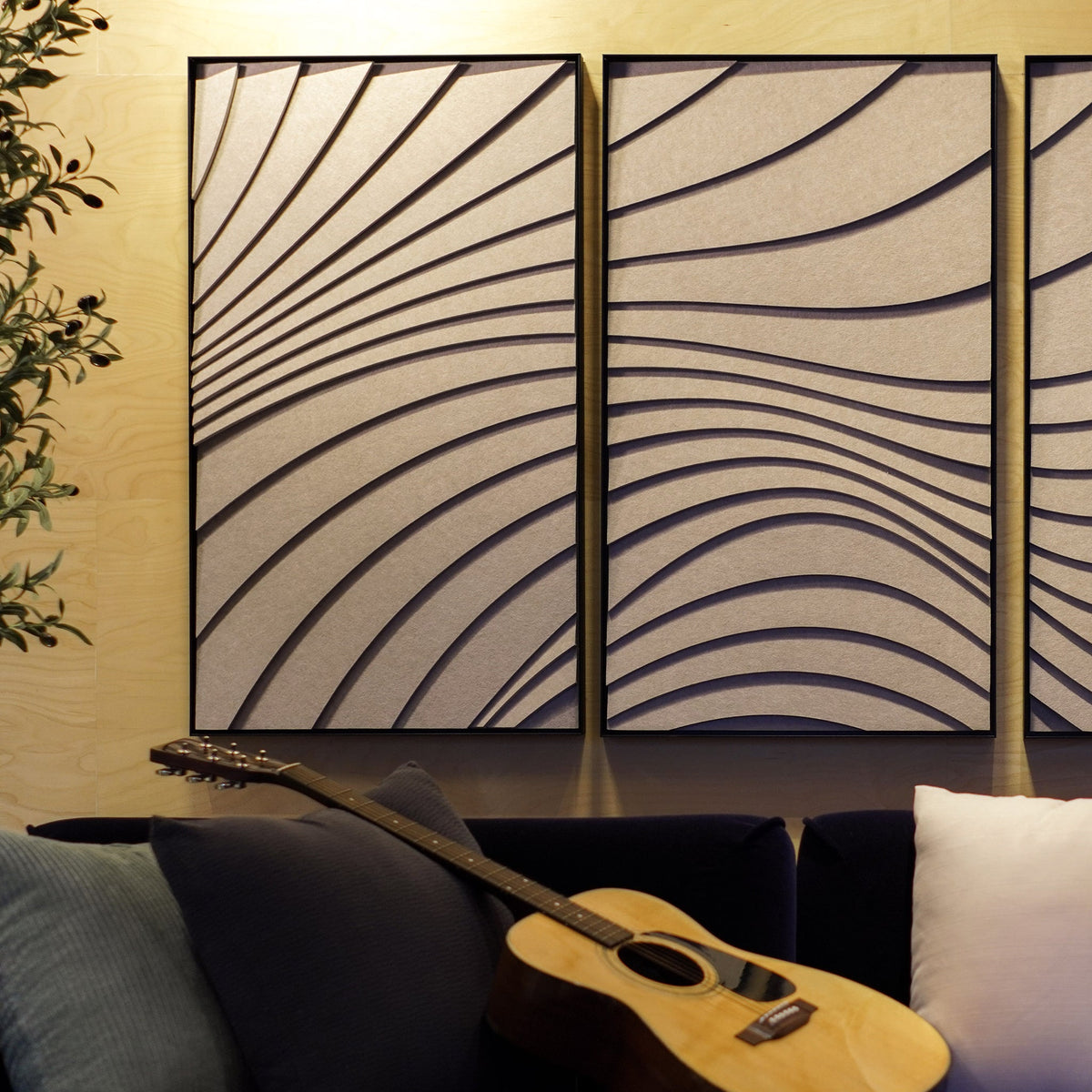
Acoustic panels look expensive one at a time, and nobody treats a room with one. The price that matters is the room's. For the example living room in Hear your room, the page's estimate is four Wave sets: 12 panels, USD 2,796. The money buys dense felt, depth and the air behind it, a shape that puts more felt in the sound's way, and test reports you can read. Whether it is worth it comes down less to acoustics than to one question: is the panel also the thing you want on the wall?

How much does it cost to acoustically treat a room?
Take Hear your room's example: a 5 × 4 m living room (about 16 × 13 ft) with a 2.7 m ceiling, a wooden floor, plasterboard walls and a window. The page estimates its echo time for voices, 500 Hz to 2 kHz, at 1.70 seconds. The page's comfortable range for a living room is 0.5 to 0.8 seconds.
Asked for the fewest Wave sets that get it there, the page says four, which bring it to 0.70 seconds. Three sets reach 0.82 seconds, just short of the range.
- What you hang: 4 Wave sets, 12 panels of 950 × 550 × 50 mm (about 37.4 × 21.7 × 2 in).
- Panel face: 6.27 m² (67.5 sq ft), about 13% of the wall area.
- Price: USD 699 a set of three, USD 2,796 for the room, at the store's prices in October 2026.

Your room will not be this room. Hear your room is an estimate, not a measurement: in Massform's own studio it came within 8% of the measured result from 250 Hz to 4 kHz, but it knows only what you tell it, not your furniture or where the panels will hang. Plan in 3D takes both into account, and is an estimate too. Put your own room in and listen before you spend anything.
Acoustic panel cost per square foot
Per-area prices only compare when the basis is stated, because panels are sold singly, in packs and in sets. On Massform's published basis, Wave works out at USD 446 per m² of panel face, about USD 41 per sq ft: two sets, six panels, USD 1,398, covering 3.135 m² (33.7 sq ft). That is per area of panel, not of wall: in the example, 12 panels cover 13% of the walls.
Why are acoustic panels so expensive? What the money buys
Are all acoustic panels equal? No. What a panel is made of changes what it absorbs, and how deep it is changes how low it reaches. Here is what the money buys in a high-end panel, with Massform's own as the example: the material, the depth, the shape, and evidence you can check.
Dense felt, not light foam
Sound is air moving back and forth. In an open, fibrous material the air squeezes in and rubs against the fibers, and the friction turns sound into heat. Density decides how well that works: too loose and sound slips through, too dense and it bounces off.
Foam is light, cheap and easy to put up. It soaks up the highs, but a common 50 mm foam takes only about a fifth of the sound at 250 Hz, so a foam-treated room loses its sparkle and keeps its boom. Glass and stone wool boards, wrapped in fabric, are the studio classic and absorb evenly from the low mids up. Polyester (PET) felt is the third way: dense polyester absorbs about as well as mineral wool of similar density, though thickness for thickness mineral wool still edges it. PET felt is a polyester textile, so there are no mineral fibers to handle, and it holds its shape over time. Massform uses dense polyester (PET) acoustic felt, on record at 207 to 226 kg/m³, and it can be shaped.

The compare page draws a reference curve for each class: one common product of each type, bare, from its maker's published laboratory test, brand not named. A 25 mm foam reads NRC 0.50, a 50 mm foam 0.70, and 50 mm glass-fiber and mineral wool boards 1.00.
Depth: the panel and the air behind it
The thicker an absorber, the lower it reaches, and air behind it counts. In the laboratory test behind Surge Pro and Wave, the 50 mm panels were raised 35 mm off the surface with no edge seal, and the report counts that air layer as part of the product. With a Basstrap Pro, each panel sat on a 50 mm Basstrap of the same size, 100 mm in all. Without it, the absorption coefficient first reaches 1.0 at 500 Hz. With it, at 200 Hz.

Shape: more felt in the sound's way
The sculpting is the mechanism: depth, slats and angles put more felt in the sound's way. Measured from our 3D models, Surge Pro's lifted layers expose about 70% more felt than a flat panel. Rhythm Pro's slats stand out from the wall, so sound reaches both sides of every slat: more than four times the felt of a flat fabric-wrapped panel the same size. Cymbals Pro's tilted discs give sound more than three and a half times the felt of a flat panel. Surface is not absorption, so the extra felt counts most in the mids; the bass still needs depth. Their frames, and Wave's, are brushed anodized aluminum.

Evidence you can check
Surge Pro and Wave carry one laboratory result. The Acoustics Lab at National Taiwan Ocean University (NTOU), a TAF-accredited laboratory, tested 50 mm panels in the Surge Pro 2′ × 4′ and Wave sizes to ASTM C423-22: NRC 0.95 without a Basstrap and 1.15 with one, reports A-10-2025 and A-11-2025. Both can be downloaded in Massform's English translation, with the laboratory's Chinese original attached in full, from Behind the Numbers. When Massform gives two NRC figures for one panel, the first is the panel alone and the second is with a Basstrap behind it. The in-room measurements behind Rhythm Pro and Cymbals Pro are published as raw REW files, with the empty room they were measured against, for anyone to open.

Are acoustic panels worth it?
First, what is true in the other direction. A bare 50 mm fiber board is cheaper than a sculpted felt panel, and on its own it is stronger in the bass. On the compare page's octave chart, the 50 mm boards read 0.15 to 0.25 at 125 Hz and about 0.70 at 250 Hz; Surge Pro and Wave on their own sit under them at both, at 0.13 and 0.54. With a Basstrap behind, they reach 1.15 at 250 Hz. The laboratories and mountings differ, so read that as a guide, not a ranking.
So if the panel goes behind a sofa, in a room nobody looks at, the cheaper board does the work. It has one job and no audience. Acoustic panels are worth the money when the panel is also the thing you want on the wall. A living room wall gets looked at every day, and a sculpted set from the Art Series is the art and the treatment at once: one object where there would otherwise be two. Nothing stops a room having both, sculpted panels where people look and plain boards where they do not.

How to choose acoustic panels
- Price the room, not the panel. Start from a count for your room.
- Ask where the NRC came from: the laboratory, standard and report number, or the in-room method.
- Check the depth, panel plus air gap, and that the figure you are reading was measured with it. Depth decides how low the panel reaches.
- Decide which walls are on show, and spend there.
What panels cannot do, and what we have not measured
- Panels absorb; they do not soundproof. Felt calms the room you are in; it does not stop the neighbors hearing you.
- The deepest bass needs more depth than a wall panel has. Even with a Basstrap, the NTOU report reads 0.25 in the 125 Hz band.
- Not every product has a measured figure. Eclipses Pro has no verified NRC yet; its independent test is pending. Color Field's and Moogdulation's NRC figures are estimates, not measurements, and some with-Basstrap figures, Rhythm Pro's and Cymbals Pro's among them, are calculated rather than measured.
- The reference curves are not ours. They are the makers' own laboratory results. We plan to measure them side by side in our own room, and have not yet.
Questions people ask
How much do acoustic panels cost?
A Wave set of three panels is USD 699 at October 2026 prices. The room is the better number: Hear your room's example living room takes four sets, USD 2,796, by its estimate. A larger or barer room needs more; soft furniture and rugs often mean fewer.
Can I start with fewer panels?
Yes. In the same example, two Wave sets take the echo time from 1.70 to 0.99 seconds: not yet in the comfortable range, but most of the way there. More sets can follow later.
Do expensive acoustic panels absorb more than cheap ones?
Not because of the price. Absorption follows the material, its density and depth, and how much of it the sound can reach. On NRC, a good 50 mm fiber board lands close to Surge Pro, though the laboratories and mountings differ. What the premium buys is the design, the finish and evidence you can check.
Do acoustic panels soundproof a room?
No. They absorb sound inside the room, which shortens the echo and makes voices clearer. Stopping sound passing through a wall takes mass and airtight construction.


Share:
The Hi-Fi Living Room: Audition the Room Before the Gear
How Many Acoustic Panels Do I Need for My Room?