

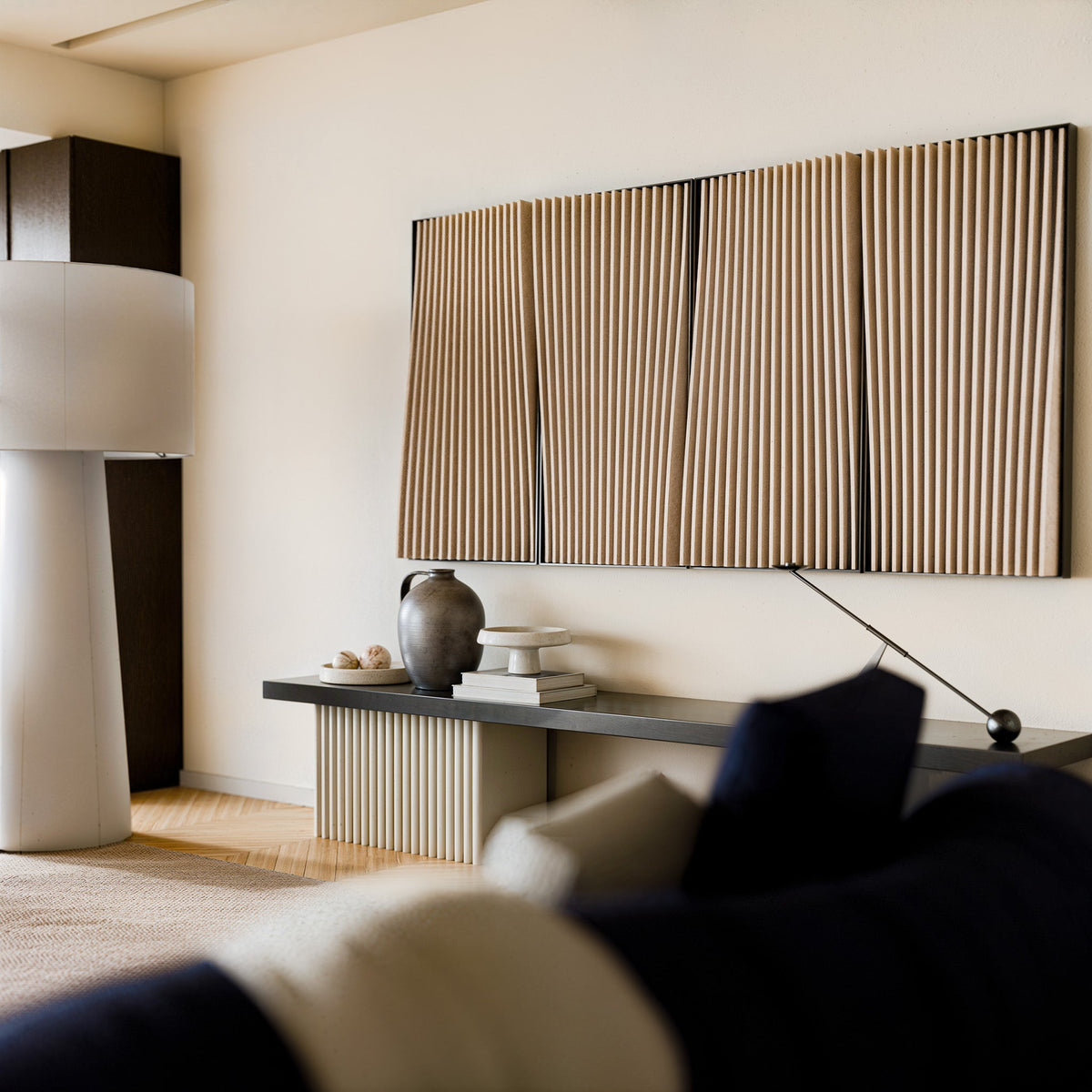
Put the first acoustic panels on the side walls, where sound from your speakers or TV bounces once on its way to your seat. A mirror and a patient friend will find those spots, or Plan in 3D will find them around your own sofa, doors and windows. After that, the wall is mostly a matter of composition, which is the enjoyable part.
Where to put acoustic panels first: the side walls
Sound from each speaker reaches you twice: directly, then again off the side wall. Take speakers 2 m (6.6 ft) apart, your seat 2 m from each, in a room 3.6 m (12 ft) wide. The bounce travels 3.12 m against the direct 2.00 m, so it arrives about 3 milliseconds later and only about 4 dB quieter (distance alone; speaker directivity ignored).

That is far too soon to hear as an echo, so your brain folds it into the original. This is the precedence effect: the first arrival sets where you hear the sound, and the late copy is merged into it. The cost is focus. A voice that should sit dead centre gets wider and blurrier.
Why so fussy? With your eyes closed, you can tell when a finger snap in front of you moves by about one degree, partly because your brain notices when one ear hears it about 10 microseconds before the other. By that standard a reflection 3 ms late is an age, long enough to smear a singer between your speakers.
EBU Tech 3276, the European Broadcasting Union's standard for reference listening rooms, asks that reflections in the first 15 ms be at least 10 dB below the direct sound, from 1 to 8 kHz. From distance alone, the example room would need to be just over 7 m (23 ft) wide. Few living rooms are.
A panel that absorbs 90% of the sound reaching it cuts the bounce by 10 dB. Felt gets close in the mids and highs: on its 35 mm air-gap spacer, Surge Pro's laboratory absorption coefficient is 0.84 or higher in every third-octave band from 400 Hz to 5 kHz (NTOU, ASTM C423-22). At 250 Hz it reads 0.59, and less again in the bass. So a panel at the bounce point cleans up voices and detail, and leaves the low end largely as it was.

The mirror trick for first reflection points
Sit where you listen. Have a friend hold a mirror flat against the side wall at the height of your ears and slide it slowly along. Wherever you see a speaker in the mirror, that is a first reflection point. Mark it, then repeat for the other speaker and wall; with a TV, look for the screen. Of the two pieces of equipment, the friend is usually the harder to source. Cover each mark with some panel to spare, since nobody sits perfectly still. Find the bounce. Put a panel there.
Plan in 3D does the same geometry around your own furniture, doors and windows. It marks each first bounce on the walls and ceiling, and every + puts the next panel on the loudest one still uncaught. It finds the bounce points; it does not prove a layout sounds best, because its placements have not yet been measured in a real room.
When a sofa, TV or window owns the reflection point
A sofa against the side wall is easy: the bounce lands above it, at ear height, and the panel goes there. A window, a door, a TV on that wall or a tall bookshelf is harder, because a panel cannot go there. Slide the panel just past its edge so it still covers part of the spot; Plan in 3D does the same.

Should panels go at first reflection points at all?
Not everyone thinks so. Siegfried Linkwitz, co-creator of the Linkwitz-Riley crossover, argued that absorbers there take the top off a reflection and leave the rest, so it no longer matches the direct sound. He preferred side walls left alone, absorption behind the listener, and speakers that send the same tone in every direction. Felt absorbs strongly from about 400 Hz up and much less below that, so his point applies here too, above all with speakers like his. A box speaker already sends a duller sound sideways, so its reflection was never a faithful copy, and he wrote that box speakers seem to do best in deader rooms. With dipole or omnidirectional speakers, try the room without side panels first.
There is also taste. Floyd Toole's research found many listeners enjoy side reflections as a sense of space. Some people like the extra width. If you mix, or want every voice pinned in place, you probably will not.
Ceiling clouds and corners
The ceiling has a first reflection point too. A panel hung there on a Cloud Kit catches it; Plan in 3D hangs clouds 25 cm (10 in) below the ceiling. No laboratory test exists for a hung panel, so the planner rates a cloud with the wall-mounted data and says it likely absorbs more at low frequencies than that shows. Nobody has measured a cloud against a wall panel, so no advantage is claimed here. A cloud is a place for felt when the walls are spoken for.

On a Corner Kit, a panel mounts across a corner at 45 degrees with a cavity behind it. That mount is untested too, so the planner rates it with the same wall-mounted data and says it likely absorbs more at low frequencies than that shows. No corner advantage is claimed here either.
Acoustic panel layout ideas: five layouts with panel counts
Once the bounces are caught, the remaining panels mostly work on the echo, which depends far more on how much the room absorbs in total than on where each panel hangs. So they can go where the wall looks right. The layouts below use the Modular Series, one with a Wave set from the Art Series, and Plan in 3D can turn a layout into a cart from what is in stock.
- The mirror pair (2 panels). Two Rhythm Pro 2′ × 4′, vertical, one on each side wall at the mirror point.
- A run behind the sofa (4 panels). Four Surge Pro 2′ × 4′ in a row, tops on one level line. The wall behind your head is where even Linkwitz wanted absorption.
- Centrepiece and field (7 panels). A Wave set flanked by four Surge Pro 2′ × 2′ in the same colourway, two stacked each side.
- A frame around the TV (4 panels). A Rhythm Pro 2′ × 4′ either side of the screen and two Rhythm Pro 2′ × 2′ above. This one is for the echo and the eye: the TV's first bounces land elsewhere.
- A cloud over the dining table (4 panels, 4 Cloud Kits). Four Rhythm Pro 2′ × 2′ hung as a square, centred over the table.

How far apart should acoustic panels be?
Spacing is mostly visual. The Art Series installation guide hangs a set of three 550 × 950 mm panels 25 to 75 mm (1 to 3 in) apart, so a set takes 1.7 to 1.8 m (67 to 71 in) of wall. At 25 mm a set reads as one piece; at 75 mm, as three. Spacing also helps a little: sound bending round each panel's edges is absorbed too, so spaced panels absorb more per panel than continuous coverage. That edge effect is part of why laboratory values can pass 1.0.

How high should acoustic panels be?
A panel that catches a bounce goes where the bounce lands, between the height of your speakers' tweeters and your ears when seated. With speakers on stands the two are close, so centre the panel on your seated ear height, measured on your own sofa. A 2′ × 4′ hung vertically covers 1175 mm (46 in) of height, enough for listeners of different heights. Panels hung for the eye can share one level line, or align with a door head.
What panels cannot do, and what has not been measured
- Panels at reflection points buy clarity: a firmer centre, a cleaner voice. They will not cure a room that booms; that depends mostly on where the speakers and your seat sit.
- Panels absorb sound in the room. They do not block it to or from the neighbours.
- Plan in 3D's echo times are estimates, not measurements of your room. Clouds and corner mounts have no test of their own.
Frequently asked questions
Should acoustic panels go behind the speakers or the TV?
Not first: the bounces that blur the image land on the side walls and ceiling, and Plan in 3D never puts a panel on the wall behind the sound. Behind speakers, pulling them 50 cm to 1 m (20 to 40 in) out from the wall mostly helps the bass. That is another article.
Should acoustic panels be vertical or horizontal?
At a reflection point, vertical covers more heights, which suits one seat. Horizontal covers more of the wall's length, which suits a long sofa where each seat's bounce lands a little further along.
How many acoustic panels do I need?
Two at the side-wall points is the start. The total depends on the room's size, surfaces and use, and how many acoustic panels do I need works it through.



Share:
How Thick Should Acoustic Panels Be?
The Hi-Fi Living Room: Audition the Room Before the Gear