

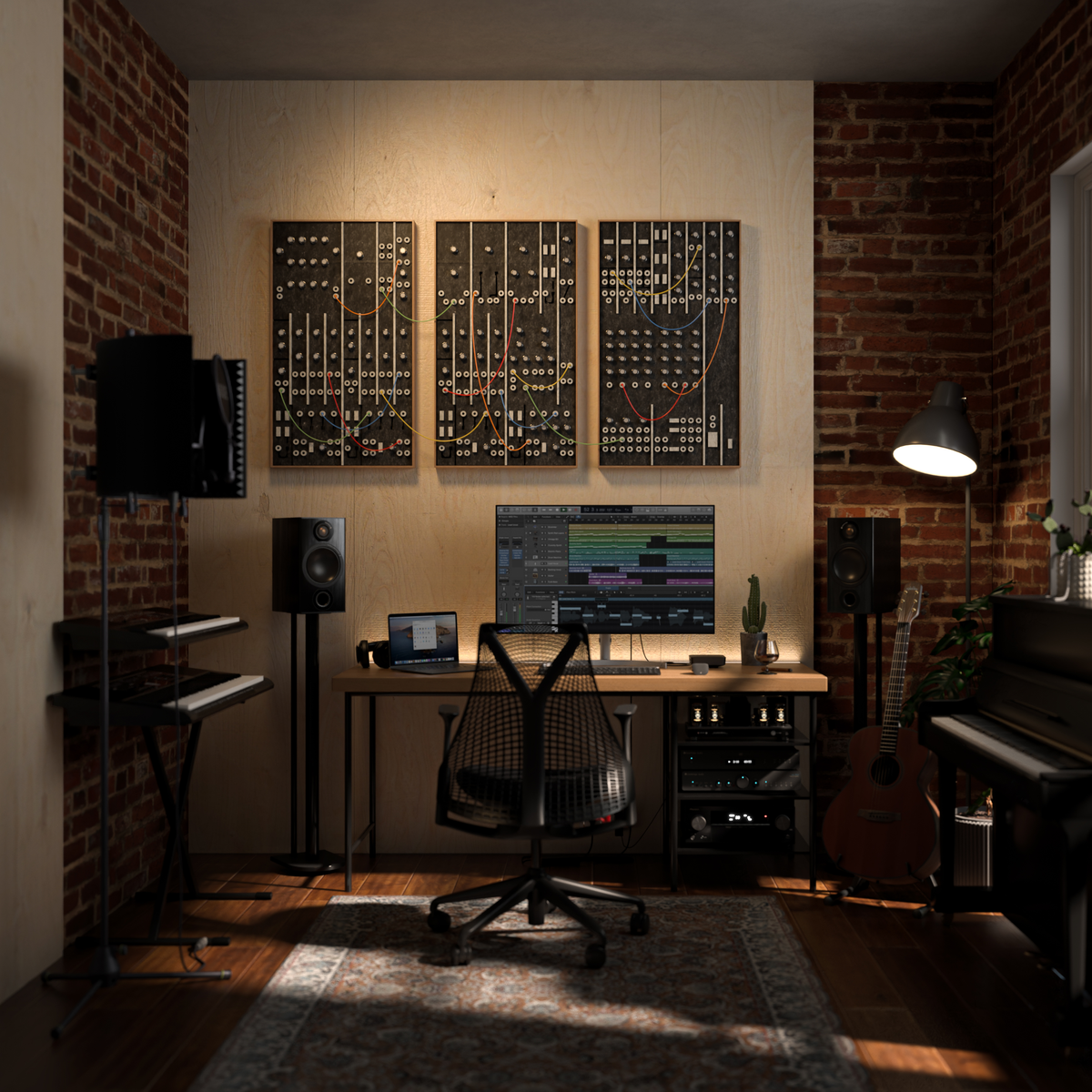
In the shop, the speakers sounded like a million dollars. At home, more like a thousand. Same speakers, same amplifier, same song. What changed is the room, and it is the one part of the system nobody auditioned. The shop did not trick you: its listening room has been set up and treated, and it is the reference to match. Auditioning your own room costs almost nothing. The order: seat and speakers, echo, side-wall reflections, how much treatment, and room correction last.

Why do my speakers sound better in the shop?
Below about 300 Hz, the room sets most of what you hear, not the speaker (Floyd Toole, 2015). Bass wavelengths run to several metres, as long as your room or longer, so the low notes pile up in some places and cancel in others. A speaker that measured flat to within 2 dB in an anechoic chamber measured anywhere from 10 dB too loud to 15 dB too quiet in a living room (Mapp, 1985). A good dealer's listening room has had that work done.
Hi-fi living room setup: the seat and speakers first
This step is free, and for the bass it does more than any panel. Pull the chair or sofa off the back wall. Bring the speakers out from the wall behind them a little; 50 cm to 1 m mostly helps the bass. Play a steady bass line, move the seat in small steps, and stop where the bass sounds even.
In a simulated living room of 5 by 4 m (our model, not a measurement), moving the seat half a metre changed some bass notes by more than 10 dB. In our own studio, measured, four microphone spots read up to 10.7 dB apart between 55 and 200 Hz, while five sweeps at one spot agreed within 0.4 dB: the difference was the spot, not the measurement. A 1994 blind test at the National Research Council of Canada points the same way: where a speaker stood mattered more than which speaker it was (Ryan).

The clap test: listening for flutter echo
Clap once in the middle of the room. A metallic zing is flutter echo: sound bouncing between two bare, parallel walls. Your music bounces the same way, and blurs. Treat one wall of each bare pair, let a thick rug do the same job between floor and ceiling, and clap again.
Side-wall reflections and the mirror trick
If the singer is not pinned between the speakers, the side walls are the usual suspects. In a typical room, the side-wall bounce reaches you about 3 milliseconds after the direct sound, and barely quieter. That is too soon to hear as an echo, so your brain blends it in: the voice gets wider and blurrier, and its tone changes. Studios work to a rule that anything arriving in the first 15 milliseconds should be at least 10 dB quieter.
Hence the mirror trick. Sit in your listening seat and have a friend slide a mirror along the side wall. Wherever you can see a speaker in the mirror, that is the spot. A panel there that absorbs 90 percent of the mids and highs reaching it turns that part of the bounce down by 10 dB.

The speaker designer Siegfried Linkwitz argued against absorbing side-wall reflections. An absorber there takes the mids and highs out of the bounce and leaves the bass, so the reflection no longer sounds like the speaker. His own designs were built to send the room the same tone they send the listener. Box speakers, which most people own, already send a duller sound sideways, and he wrote that they seem to do best in fairly dead rooms. So the right fix depends on the speaker. For speakers like his own dipoles and omnis, he wanted a livelier room: side walls left reflective, and the wall behind the listener absorptive.
How much acoustic treatment does a listening room need?
Aim for a reverberation time of about 0.3 to 0.4 seconds, and stop there. That is where IEC TR 60268-13, whose listening room is modelled on an average living room, meets the broadcasters' reference rooms in EBU Tech 3276.
This is also where the "too many panels" argument ends. Panels work mainly from the low mids up. In our studio (19.6 m² of floor), eight Rhythm Pro 2' x 4' panels on one wall, 5.4 m² of panel face or about a tenth of the wall area, made the decay (octave-band T20) about a quarter shorter from 1 to 8 kHz and 3% shorter at 125 Hz. Keep adding panels past the target and the room keeps losing treble while the bass barely moves, which is the one combination nobody asks for.

Hear your room estimates your room's echo time from its size and surfaces, and plays a voice through it as it is and with panels. Its figures are an estimate, not a measurement, and it tells you when panels pass half the walls. The count itself is in How many acoustic panels do I need?
Room correction vs room treatment
Room correction measures the sound at your seat and builds a filter to even it out. It is the right tool for the bass, which is exactly where panels stop: Massform claims nothing for its panels below about 150 Hz. Above the bass, Toole and Linkwitz both warned that room equalisation tends to do more harm than good. A reflection is a late copy of the music, not a wrong level. An equaliser can turn a frequency down. It cannot make a reflection arrive on time.
Panels do the other half: they shorten the decay and tame reflections across the whole room, not only at the seat where the microphone stood. So place the seat and speakers, treat, and run correction last.
Hi-fi living room design: treatment as furniture
- The side walls, at the mirror spots: Rhythm Pro, felt slats set at different depths. Without a Basstrap behind it, Rhythm Pro is NRC 0.85, a Massform office REW measurement. With a Basstrap behind it, NRC 1.00, calculated, not measured.
- The wall behind you: a centrepiece from the Art Series. It is the one wall Linkwitz wanted absorptive, though he used heavy curtains.
- The corners: a panel with a Basstrap Pro behind it, hung across the corner on a Corner Kit. Low notes pile up between the walls, most of all in the corners. Basstrap Pro carries one NRC, 1.15, from the National Taiwan Ocean University laboratory test (ASTM C423-22) of Basstraps behind Surge Pro and Wave panels, raised 35 mm off the test surface. Nobody has tested one across a corner: Plan in 3D models it with the wall-mounted data, which probably understates its bass, and we claim no corner advantage. Expect the room to sound evener from the low mids up, after moving the seat and speakers.
- The records and the bookshelf: leave them. Hard, uneven things keep the room from going dead, and a living room should still sound like one.

To see a layout before drilling anything, open the Listening room example in Plan in 3D, with its speakers and record and amp shelf in place. Each panel you add goes to the loudest first bounce nothing else catches, and a panel dragged into a corner mounts on a Corner Kit. Audition the room. Then the gear.

What panels cannot do
- Fix the deepest bass. Below about 150 Hz, position, a subwoofer and room correction do that work.
- Keep the sound in. Panels absorb; they do not soundproof. Stopping sound reaching the neighbours is a construction job.
- Stand in for a measurement. Hear your room came within 8% of our measured studio and may be further out in yours. Plan in 3D treats the stereo pair as one source midway between the speakers, so read its bounce points as zones.
- Carry a laboratory report for everything. Rhythm Pro's figures are our own office measurement, and no corner-hung panel has been tested. The half-metre seat figure is a simulation, the 10.7 dB is our studio, and your room will differ from both.
Hi-fi living room FAQ
Why do my speakers sound better in the shop than at home?
The shop's listening room has been set up: seat and speakers placed for even bass, reflections and echo under control. Set yours up in the same order and the shop becomes a reference you can match.
Is room correction better than acoustic panels?
They do different jobs. Correction evens the response at one seat and is the right tool for bass. Panels shorten the decay and tame reflections across the room, which a filter cannot do. Treat first, correct last.
Can a listening room have too many acoustic panels?
Yes. Panels work mainly from the low mids up, so past about 0.3 to 0.4 seconds the room keeps losing treble while the bass barely moves. Stop at the target and handle the bass with position and correction.
Do I need bass traps for a hi-fi living room?
Not first: move the seat and speakers. In the laboratory test, a Basstrap behind Surge Pro and Wave panels moved the point where absorption reaches full (a coefficient of 1.0) down from 500 Hz to 200 Hz. Below about 150 Hz, rely on position, a subwoofer and room correction.



Share:
Where to Put Acoustic Panels, and How to Lay Out the Wall
Why Are Acoustic Panels So Expensive, and What Does a Room Cost?