

Bass is where sound gets physical.
It moves the air, hits the body, and defines the energy of a space. But in untreated rooms, it also causes the most chaos: boomy corners, muddy mids, uneven playback.
When you think of acoustic testing, you probably imagine laboratories, precise measurements and gold-standard charts. That picture is right. The catch is in the summary: the laboratory measures from 100 Hz up, but NRC, the single number most panels are sold on, leaves out everything below 250 Hz, which is where the bass lives.
So, do you need bass traps? Often yes, but rarely first. Moving your seat and your speakers costs nothing, and it often changes the bass at your seat more than new equipment does. If the room still booms after that, a Basstrap Pro behind your panels is the next step. This page sets out what it does in the laboratory, what it does not do, and where it goes.

Do You Need Bass Traps? The Short Answer
- Probably, if the bass booms at your seat and goes thin a step away, one note rings on after the rest of the music has stopped, or mixes that sound right at your desk sound wrong everywhere else.
- Probably not first, if the problem is echo: voices that blur, calls where people ask you to repeat yourself, a room that clatters. Panels do that job, and a Basstrap can go behind them later.
- Not the answer, if the problem is noise from next door, or the deepest bass, below about 150 Hz. The first is soundproofing, a different job. The second belongs to where things sit, and to equalisation.
What Makes Bass Hard to Control?
- Low frequencies, roughly 20 to 250 Hz, have long wavelengths: at 80 Hz, one wave is over 4 metres (about 14 ft) long
- These waves bounce between walls and corners, creating standing waves
- Result: some notes boom, others vanish, and your room lies to your ears
In our model of a bare living room, moving the chair half a metre (20 in) changed some bass notes by more than 10 dB. In our own studio, measured, the four microphone positions of our published sweeps read up to 10.7 dB apart between 55 and 200 Hz. Same room, same speaker, same sweep.
What the Lab Does Tell You About Bass
Rather a lot, as it happens. The standard laboratory test for absorption, ASTM C423, measures in one-third octave bands from 100 Hz to 5 kHz. The bass from 100 Hz up is in the report; below that, the test gives no figure.
It is the summary that leaves it out. NRC is the average of four bands, 250, 500, 1000 and 2000 Hz, so nothing below 250 Hz goes into it.
But that’s exactly where most rooms struggle: bass build-up, muddy resonance, and standing waves that turn mixes into guesswork.
So if a panel claims a great NRC but doesn’t talk about bass... you’re only getting half the picture. Ask for the bands.
What the Basstrap Pro Is
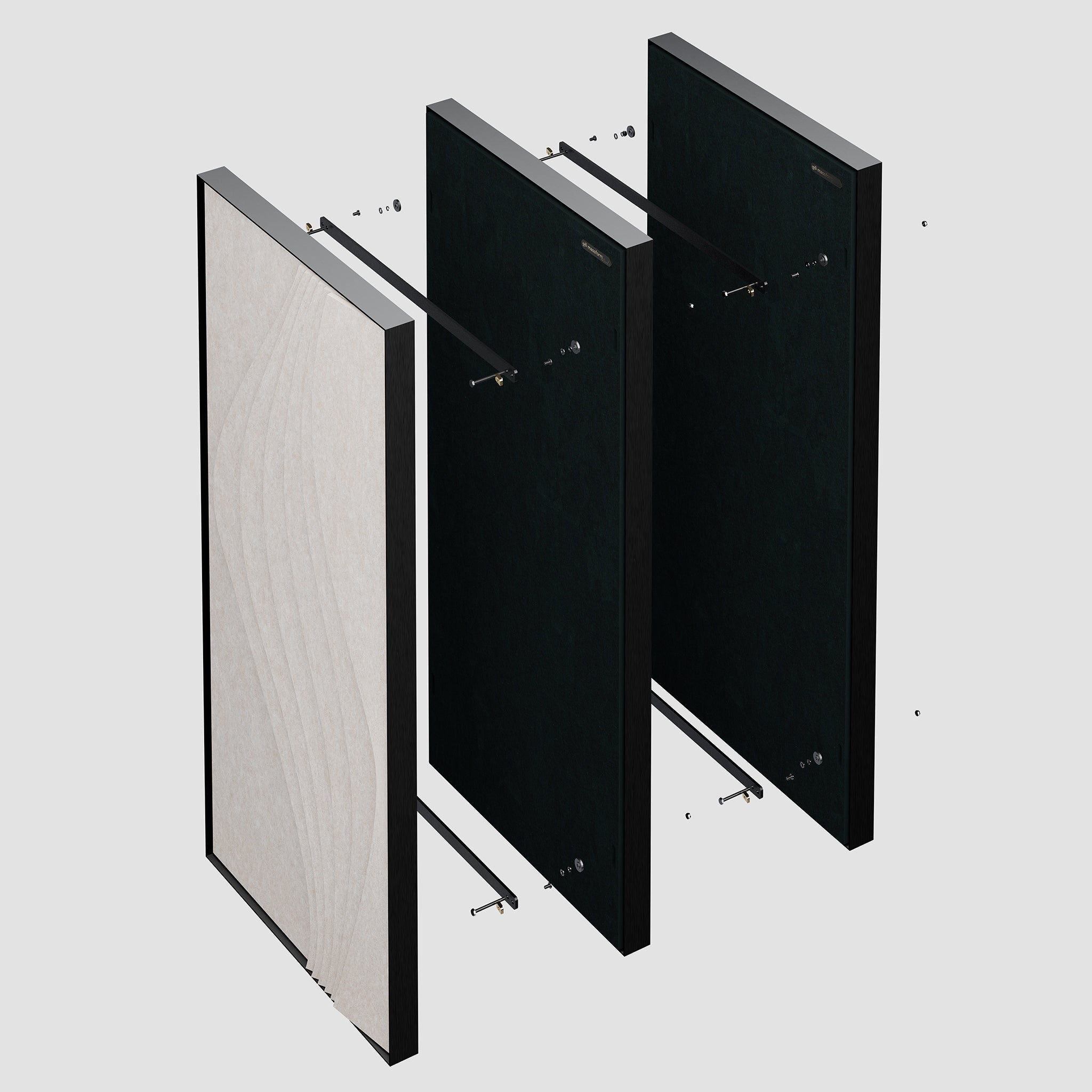
- A layer behind the panel: a slim black unit of PET acoustic felt, 50 mm (2 in) deep, made in 2'x2', 2'x3' and 2'x4' to bolt flush behind a panel of the same size, such as Surge Pro, Wave, Rhythm Pro or Cymbals Pro.
- Out of sight: from the front, you see the panel, not the trap. The design on your wall stays the one you chose.
- Depth where bass needs it: felt absorbs by slowing moving air. Right at a wall, a low note barely moves the air; it moves most further out, so bass needs depth. An air gap helps one band of lower notes (what an air gap does). A thicker layer of felt is what takes the absorption lower.
-
Install-friendly: on a wall behind its panel, or across a corner on a Corner Kit. No framing required.
A Surge Pro panel with two Basstrap Pro layers behind it. The laboratory tested one layer; more on that below.
What the Laboratory Measured
Surge Pro and Wave were tested by a university laboratory, the Acoustics Laboratory at National Taiwan Ocean University (NTOU), to ASTM C423-22: 19 panels of the construction the two share, about 11 m² in all. They were tested once on their own, raised 35 mm (about 1.4 in) off the test surface with the edges left open, and once with each panel on a 50 mm Basstrap of the same size (reports A-10-2025 and A-11-2025).

- Full absorption reaches lower. The absorption coefficient first reaches 1.0 at 500 Hz without the Basstrap, and at 200 Hz with it.
- The upper bass comes up. At 160 Hz, absorption rises from 0.21 to 0.83, about four times as much.
- The deep bass mostly does not. At 125 Hz, with the Basstrap, the coefficient is 0.25: it takes in about a quarter of the sound that reaches it. Below about 150 Hz we make no claim for it.
| Frequency (Hz) | Panel alone (A-10-2025) | Panel on a Basstrap (A-11-2025) |
|---|---|---|
| 125 | 0.08 | 0.25 |
| 160 | 0.21 | 0.83 |
| 200 | 0.31 | 1.00 |
| 250 | 0.59 | 1.18 |
| 315 | 0.73 | 1.28 |
| 400 | 0.95 | 1.31 |
| 500 | 1.15 | 1.19 |
Absorption coefficients, NTOU Acoustics Laboratory, ASTM C423-22. Values above 1 are common in this test: the panels sat 35 mm up with the outer edges of the array open, so sound got in at the edges and underneath as well as at the face, and all of it is divided by the face area alone. More in why NRC can go over 1.0.
Surge Pro and Wave: NRC 0.95 without Basstrap, NRC 1.15 with Basstrap (NTOU, ASTM C423-22).
The Basstrap Pro is listed at one figure, NRC 1.15. It is the same tested configuration, a panel on a Basstrap. The Basstrap was never tested on its own, because it is made to sit behind a panel.
Rhythm Pro and Cymbals Pro publish with-Basstrap figures too. Rhythm Pro reads NRC 0.85 without Basstrap and 1.00 with it; Cymbals Pro reads 1.35 without and 1.50 with. Those are Massform office REW measurements, made in the studio described below and corrected band by band against Surge Pro's laboratory result. The with-Basstrap figures add the laboratory's Basstrap difference by calculation; they are not measured.
- Report A-10-2025, panels alone (PDF: our English translation, with the laboratory's original attached)
- Report A-11-2025, panels on a Basstrap (PDF: our English translation, with the laboratory's original attached)
One Layer, Tested
The Basstrap is modular, and in principle more depth reaches lower notes. The catalogue shows panels with two Basstraps behind them, and so does the video above. The laboratory has seen one. We publish what the laboratory has seen, so every Basstrap figure on this page is for a single 50 mm layer, and there is no number here for two.
What We Measured in a Room
We also measure in our own studio (19.6 m² of floor, 55.5 m³), using:
- Calibrated UMIK-1 mic
- REW software
- Four mic positions, 20 sweeps per condition
- Treated vs. untreated decay curves

With 8 Rhythm Pro panels on one wall and no Basstrap, 5.4 m² of panel face or about a tenth of the wall area, the reverberation time (T20, averaged over the four positions) fell by about a quarter from 1 to 8 kHz: 0.53 s to 0.39 s at 1 kHz. At 250 Hz it fell 9%, and at 125 Hz, 3%. Panels on their own clean up the mids and highs and leave the bass almost where it was. That is the case for a bass trap, made by our own panels.
We have not yet measured the Basstrap in that room, so this page gives no in-room figure for it. The laboratory numbers above are what we have. The full run, raw files included, is in our in-room test of Rhythm Pro.
Where It Goes, in Order
- Your seat first. Pull the chair off the back wall, move it in small steps, and listen for the spot where the bass sounds most even.
- Then the speakers. Pulling them 50 cm to 1 m (20 to 40 in) out from the wall behind them mostly helps the bass. Keep left and right matched: symmetry = better stereo image. In a 1994 blind listening test at the National Research Council of Canada, where a speaker stood in the room mattered more than which speaker it was (Ryan).
- Then the Basstrap, behind panels in the corners. Bass builds up most in corners, which is why bass trapping traditionally starts there, with matching corners on the left and right. A tall corner can take more than one unit, one above another.
- Or on the wall behind the speakers, if they have to stay close to it. Sound bouncing off that wall comes back late and pulls one note down: with the speakers 30 cm (1 ft) from the wall, the dip lands near 290 Hz. That is a pitch where a panel on a Basstrap absorbs fully in the laboratory.
The first two steps need a tape measure and nothing else. As bass treatment goes, the tape measure is hard to beat on value.
What to expect from the Basstrap: a room that sounds evener from the low mids up, and far more absorption at 160 Hz than a panel gives on its own. Below about 150 Hz, placement and equalisation do the work.
A note on corners: Plan in 3D can hang a panel across a corner on a Corner Kit, at 45 degrees with a cavity behind it. The corner mount has not been tested, so Plan in 3D rates that panel with the same wall-mounted laboratory data and gives it no extra credit for the corner.

Common Questions
Do I need bass traps in every corner?
No. Start with what you can do symmetrically, usually the two corners at the speaker end, then listen again before adding more.
Bass traps or acoustic panels first?
For echo and clarity, panels first. For boom, move the seat and speakers, then add traps. With a Basstrap the choice is smaller than it looks: it bolts behind a panel, so the panel can go up now and the Basstrap later.
How many do I need?
We don't publish a rule for it. In the bass, the room's shape and where you sit matter more than any rule of thumb, and we have tested one layer, not two. Hear your room estimates how many panels a room needs and lets you add a Basstrap behind each, and Plan in 3D shows where they go. Both give estimates, not measurements, and they are least certain in the bass. For a second opinion, send a photo to the concierge, an automated acoustics concierge trained by the Massform team.
Do bass traps help with noise from the neighbours?
No. Like the panels in front of them, they absorb sound that is already in the room; they do not stop it getting in or out. Keeping sound in or out is soundproofing: sealing gaps, adding mass, decoupling walls. Acoustic treatment controls how sound behaves inside the room. More on the difference in absorption vs. soundproofing.

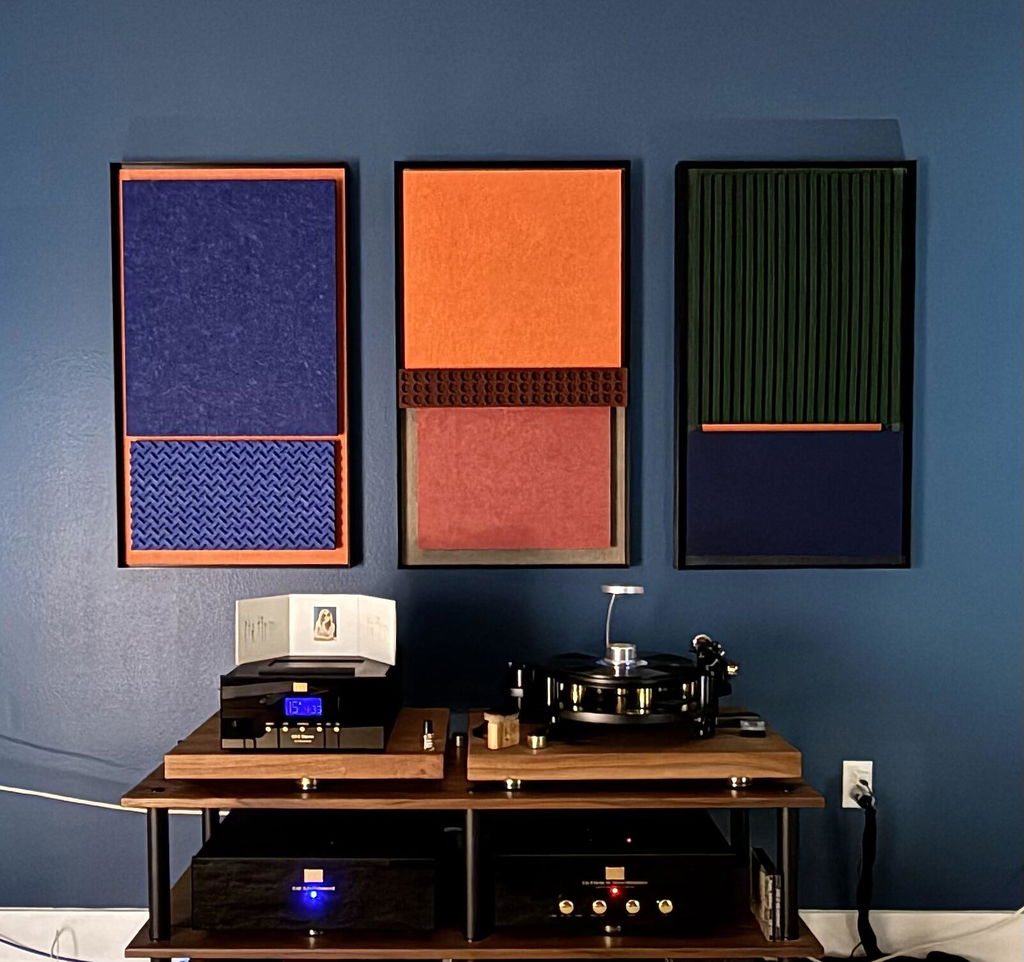
Rhythm Pro in a living room. A Basstrap behind panels like these stays out of sight.
The Basstrap Pro comes in 2'x2', 2'x3' and 2'x4', all in the Basstrap collection. To set panels side by side, with and without a Basstrap, use the compare page.
Corrections, October 2026: an earlier version of this article said one Basstrap layer cut a room's decay below 250 Hz from about 300 ms to about 100 ms. We have no measurement behind that: the Basstrap has not been measured in a room, and the laboratory figures above are what we have. It also said laboratory tests mostly ignore the low end. ASTM C423 measures from 100 Hz; it is NRC that leaves out the bands below 250 Hz.



Share:
Do Massform Panels Really Work? A Clear Answer for the Curious (and the Skeptical)
In-Room Test: Rhythm Pro Acoustic Panel