

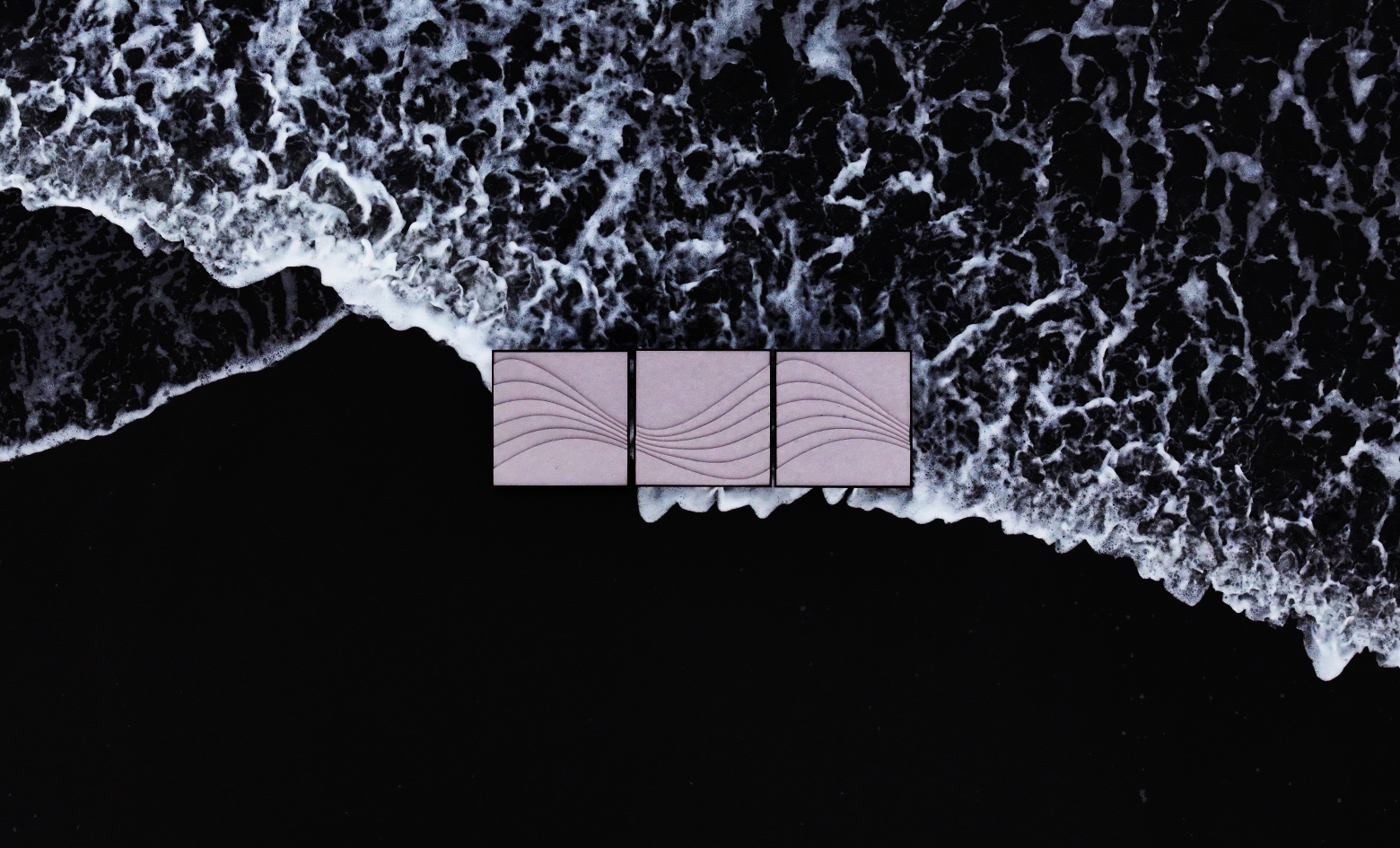
Wave & Surge: Two Expressions of the Same Motion
What does silence look like? What does motion sound like? We think the answer sits somewhere in between, in the textures of nature and in the way a room carries sound. Wave and Surge Pro came from the same place: movement, water, terrain and time. Both are 3D acoustic panels sculpted from dense polyester (PET) felt, with no fabric cover, so the face you see is the felt that does the absorbing. Two surfaces, one story.

Wave: Born From Stillness
The idea for Wave came from a quiet walk by the ocean. The tide moved like breath, folding in and out, soft and slow. Foam traced black sand and then vanished. That pause between waves carried more weight than the waves themselves.
The panel’s form follows that rhythm: soft, flowing curves, built up from overlapping layers of felt. Each layer lifts slightly off the one beneath it and leaves a small, irregular pocket. Every lifted edge and pocket puts more felt in the way of sound, and the felt absorbs it, softening a room without drawing attention to itself. The shape is not decoration laid over an absorber. It is the absorber.
Wave is designed to bring calm into a space. Not silence as emptiness, but silence as presence. It is shaped by water and made to be felt.
It suits rooms where people sit and listen: living rooms, listening rooms and home cinemas.

We also made a short film of Wave. In one shot the panel hovers over rippling water; in another it floats against a plain white background. Neither is a mounting method we recommend, but both show the curves with nothing else in the way.
Shop Wave in Sandstone or Silver Nimbus

Surge Pro: Formed By Pressure
Surge began on a different day, but not a different idea. After a storm, during a hike, the cliffs looked like they had been pushed from below. Sediment stacked in waves. Wind-carved lines. There was tension in the stillness, and that tension became Surge.
Surge Pro carries vertical energy. Its curves lean forward, like sediment pushed up from below, and give the panel depth and direction. The layers also lift off the face, which gives sound more felt to reach: measured from our 3D models, Surge Pro’s lifted layers expose about 70% more felt than a flat, fabric-wrapped panel the same size. That is a count of felt, not of absorption, which is less exciting and more accurate. The asymmetry itself is for the eye. It gives the panel a sense of motion, even in a silent room.
While Wave reads as calm, Surge Pro reads as energy. It suits rooms in motion: studios, creative spaces and hybrid workspaces where ideas move quickly.

Two Paths, One Intention
Wave and Surge Pro were not designed to be opposites. They are different ways of expressing the same idea: that sound is shaped by space, and space is shaped by time. Both draw from water and geology, from the irregularity of nature, and the fleetingness of motion. One reflects the breath between moments. The other reflects the build-up before a release.
What They Do in a Room
Different shapes, one published result. Wave and Surge Pro carry the same pair: NRC 0.95 without a Basstrap and NRC 1.15 with one, from National Taiwan Ocean University’s tests to ASTM C423-22. NRC is a single number for how much sound a surface absorbs across the range of the voice. A figure above 1 is a normal result of the room test behind it, which counts the sound that reaches the open edges of the test array as well as its face (why NRC can go over 1.0).
The felt does most of its work from the low mids up. In the lab, the panels on their own absorbed nearly all the sound that reached them from about 400 Hz to 3 kHz, the range where speech lives and where a room’s echo is easiest to hear. Low notes are another matter. They are long waves, and they need depth: at 160 Hz the panels alone absorb about a fifth of the sound that reaches them. With a Basstrap behind each one, they absorb most of it, which is what the Basstrap is for. Lower still, where a subwoofer does its work, a boom needs deeper treatment than a felt panel on a wall. Neither panel soundproofs a room. They reduce the echo inside it; keeping a neighbour’s noise out is a job for the wall itself.
Test conditions: Acoustics Laboratory, National Taiwan Ocean University (NTOU), ASTM C423-22, reverberation room. Reports A-10-2025 (without Basstrap) and A-11-2025 (with Basstrap), tested April 2025. 19 panels, 10.999 m², raised 35 mm off the test surface with the edges open; with Basstrap, each panel sat on a 50 mm Basstrap of the same size.
The Compare page draws the shared curve octave by octave, with or without a Basstrap, beside the rest of the range. To hear what a few Wave sets or Surge Pro panels would do to your own room before you buy, try Hear your room: it gives an estimate, not a measurement. Plan in 3D then shows where they go.

Whether you want a wall that reads as calm or as energy, choose by eye: the numbers are the same.
They are not just seen or heard. They are felt.



Share:
Beyond the Specs: How to Read a 1/3 Octave Chart (Without Losing Your Mind)
The Partner Acceptance Factor: Acoustic Panels the Whole Household Agrees To