

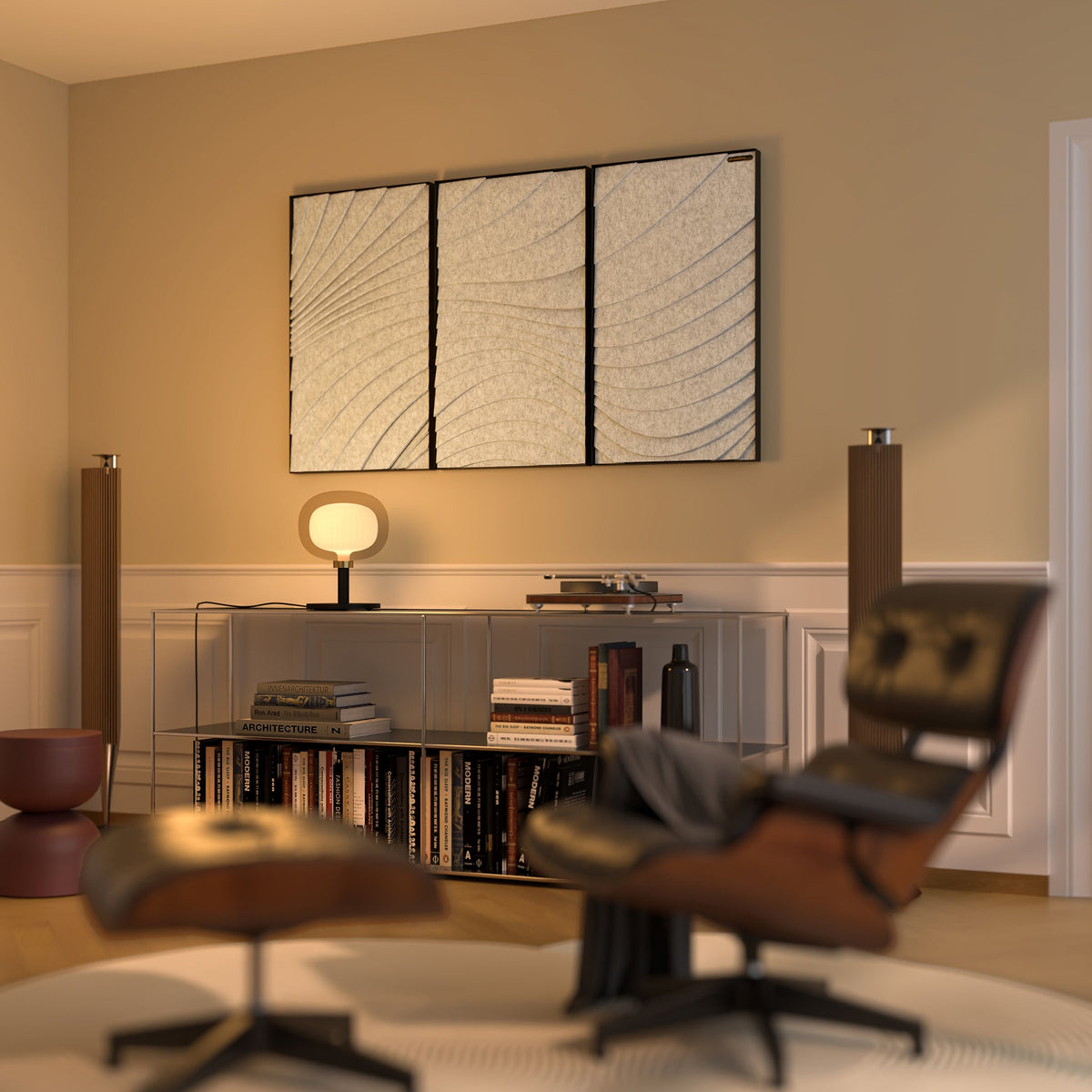
A living room echoes when almost everything in it is hard. Wood or stone floors, plaster walls, big windows and a high ceiling all send sound straight back, and with too little that is soft to take it in, every word carries on after the speaker has stopped. The fix is absorption, in a sensible order: what you already own first, then acoustic panels where furniture cannot reach, at head height and above.
Why is my living room so echoey?
A hard, smooth surface returns nearly all the sound that meets it, so a voice crosses the room again and again before it fades. That lingering tail is reverberation, and the time it takes to fade away, by 60 dB, is the room's echo time, or RT60. The usual causes, often together: hard floors, large windows, a high or vaulted ceiling, an open plan and few soft things.
The clap test: what kind of echo is it?
Clap once. A fast, metallic zing afterwards is flutter echo: sound bouncing between two bare, parallel surfaces that face each other, wall to wall or floor to ceiling.
The rule that follows: treat at least one side of every facing pair. Panels on one wall of a pair stop the side-to-side bounce. A thick rug, or panels hung from the ceiling as clouds, stops the up-and-down one. When one side is a window, the choice is made for you: treat the wall it faces.

Hear your room before you change anything
Hear your room works out a room's echo time from its size and surfaces, then plays a voice through it as it is and with panels. Its example living room is the room before anyone moves in: 5 by 4 m (16 by 13 ft), a 2.7 m (9 ft) ceiling, a wood floor, plasterboard walls and ceiling, 3 m² (32 sq ft) of glass, nothing else. In the speech band (500 Hz to 2 kHz) it rings for about 1.70 seconds, an estimate, not a measurement, against the 0.5 to 0.8 seconds the page suggests for a living room.
In our own studio (55.5 m³), starting from the empty room's measured echo time, its calculation for adding 8 Surge Pro 2'x4' panels (5.4 m² of panel face) came within 8% of the measured result at every octave from 250 Hz to 4 kHz. In your room it has to estimate the starting point as well, so expect it to differ more.

How to reduce echo in a living room with what you already own
Start with what you have already paid for. Each fix below is changed on its own in the example room: the page's estimates, not measurements, on the assumption that absorption is spread evenly, which furniture is not.
Do rugs reduce echo?
Yes: the floor is the largest single surface that is easy to change. Set the example's floor to thick carpet with underlay and the estimate falls from about 1.70 to about 0.47 seconds. Read that as the floor's best case on paper. It is wall to wall, and the page spreads its absorption evenly around the room, while a carpet keeps all of it underfoot, so a real room rings longer. A rug does part of that, a thick one on an underlay far more than a thin flat-weave, and it stops only the up-and-down bounce. The walls still face each other.
Do curtains reduce echo?
Heavy, lined curtains in full folds take in much of what the glass sends back; sheers do far less. They work when drawn, which is also when the view stops working, so glass usually needs help from the wall opposite. Hear your room offers curtains only as a finish for every wall, not over a single window, so there is no fair figure for them here.
Sofas, books and people
A three-seat sofa and two armchairs, counted as five soft chairs on the page, take the example to about 1.02 seconds. A full bookcase absorbs a little; an empty one adds nothing. People absorb sound well: seat eight guests and the example falls to about 0.94 seconds. They also make sound, which is the next section.
Where furniture stops. Furniture works mostly on the higher frequencies and sits low, leaving the upper walls, the glass and the ceiling bare. Clap again once it is in: whatever still zings is where panels go.

Dining room echo: why dinner gets louder as guests arrive
Every dinner party reaches the moment when everyone is shouting about how nice it is to see each other. Nobody decides to. It is a reflex, described in 1911 by a French ear doctor, Étienne Lombard: when the noise around us rises, we raise our voices without noticing.
At a table it becomes a loop. One end talks louder to be heard, so the other end does too, and a hard room keeps each voice ringing after it is spoken, adding to the noise everyone talks over.
The acoustician Jens Holger Rindel put numbers to the loop in a model of conversation in restaurants, set out in a 2019 paper. In his model, each doubling of the people talking adds about 6 dB of noise: about 3 from the extra voices, about 3 from everyone raising theirs. It runs backwards too: double the absorption and his model takes about 6 dB off, half because the room rings less, half because people talk more quietly. Of the whole loop, absorption is the only part you can install.
Where acoustic panels come in
Panels go where furniture cannot: the walls at and above head height, and the ceiling. In an open plan, treat the zones where people talk, usually the sofa and the table.
A set on the wall opposite the glass
The wall facing the glass is usually one you look at anyway. Wave is a set of three panels. Hear your room's bare example takes four sets, 12 panels, to reach about 0.70 seconds; with the sofa and armchairs in, two sets reach about 0.71. Both are estimates, not measurements, and the second is why the furniture goes in first.

Wave carries NRC 0.95 without a Basstrap and 1.15 with one, from the National Taiwan Ocean University test to ASTM C423-22 that Massform publishes for both Wave and Surge Pro. Wave belongs to the Art Series; sound absorbing wall art covers the others.

A cloud over the dining table
A Cloud Kit hangs a framed Massform panel from the ceiling, one kit per panel, over the table where the voices are. In Plan in 3D, the 3D planner beside Hear your room, you can hang clouds over your own table and hear the result. No hung panel has been tested, so the planner counts a cloud with the wall-mounted test data: the reason to hang one is where it hangs, not a bigger number. Overhead, follow the kit's guidance on anchors and a safety cable, and use a qualified installer.

How to reduce echo in a room with high ceilings
A tall room holds more air, so it needs more absorption for the same echo time. The page's high-ceiling example, 6.5 by 5 m (21 by 16 ft) with 4.5 m (15 ft) to the ceiling, starts at about 2.4 seconds, and the page's count for it is 11 Wave sets. Set the same room to 2.7 m high and the count falls to 6. Both are estimates, not measurements. Treat the walls at seated and standing head height first.
What panels cannot do
Bass. Panels absorb the mids and highs. In the same studio (55.5 m³, 19.6 m² of floor, about 211 sq ft), 8 Rhythm Pro 2'x4' panels on one wall, 5.4 m² of panel face or about a tenth of the wall area, made the echo time (measured as T20) about a quarter shorter from 1 to 8 kHz. At 250 Hz it moved 9%, at 125 Hz 3%. A Basstrap behind a panel reaches lower: in the test Massform publishes for Wave and Surge Pro, it moved full absorption down from about 500 Hz to 200 Hz. Below about 150 Hz, for music and films, the tools are different: where the subwoofer and the sofa sit, and the room correction in your receiver.

The neighbors. Panels work on sound inside the room; stopping it passing through walls and floors is a building job.
What Massform has not measured. Hear your room's rug, sofa and people figures come from published reference values for typical materials, and no test exists of a panel hung as a cloud.
Questions people ask
How do I reduce noise in a dining room?
Absorb the ringing over the table: a ceiling cloud or a set on the nearest wall, with a rug underneath. With less to talk over, people talk more quietly. It works on noise made in the room, not noise from outside.
How many acoustic panels do I need for a living room?
It depends on the room's size, surfaces and furniture. For its bare example, Hear your room suggests four Wave sets, and two once a sofa and two armchairs are in: estimates, not measurements. How many acoustic panels do I need has the reasoning.
Why does my room still sound boomy after adding panels?
Panels and soft furnishings take out the mids and highs far more than the bass. A Basstrap behind each panel reaches lower; below about 150 Hz, move the subwoofer and the seats first.


Share:
How Many Acoustic Panels Do I Need for My Room?
Sound Absorbing Wall Art: Which Kind Works, and What Size to Buy