

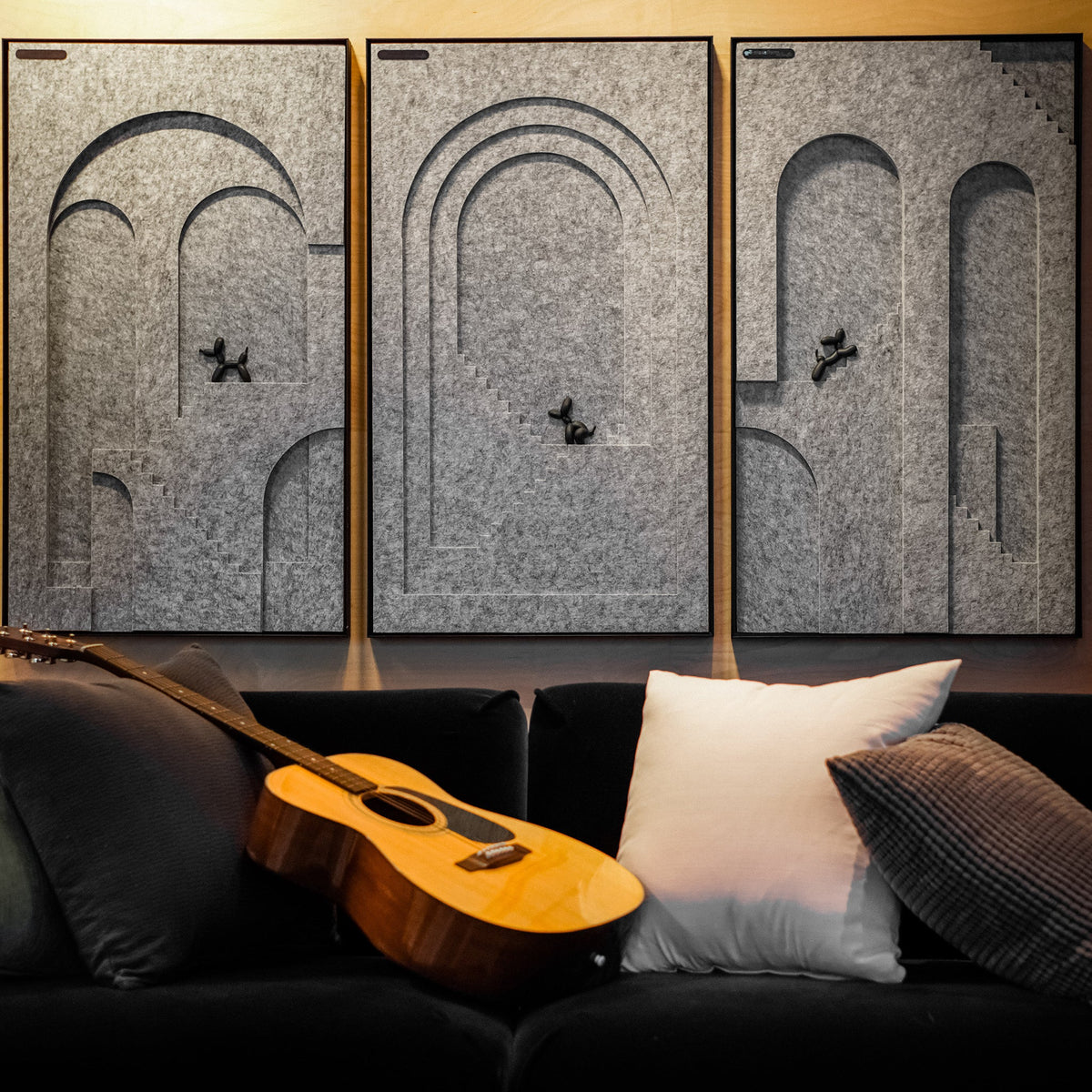
Acoustic treatment the whole household agrees to starts with how it looks. Propose one sculpted set that reads as art, not a room full of treatment. Let your partner choose the colourway. Play the room before and after so you both hear it, see the set on your own wall in 3D, and agree a limit before the first screw goes in. Much of the objection is about the wall, so much of the answer should be too.
The case for acoustic treatment usually starts with a spreadsheet. It should start with the wall.
What is the partner acceptance factor?
It is the hi-fi hobby's name for whether the other people in a home will live with your equipment. The older term is the wife acceptance factor. Spouse acceptance factor and partner acceptance factor mean the same thing, and they fit better, because the enthusiast can be anyone and so can the person who has to look at the speakers every day.

The problem is not new. In an informal poll on the Audioholics forum at the turn of 2006, 123 voters named the biggest obstacle to getting their room's acoustics right. "Do not know what to do or where to begin" got 19 votes. Renting or planning to move got 27. "Aesthetics / Decor / Spousal acceptance" got 55, about 45%.

The obstacle named most often was not acoustic at all.
Acoustic panels that look nice: propose one set, not a room
A room of treatment is a large request. One piece of art for one wall is a small one. Start with a single three-panel set above the sofa or behind the listening seat. Finished, a three-panel Art Series set such as Wave takes 1700 to 1800 mm of wall (about 67 to 71 in), depending on the gaps, and stands 950 mm (about 37 in) high, so it hangs like a large painting and is judged like one.

Sculpted felt has no fabric cover: the face you see is the absorbing material, and the depth of the sculpting puts more felt in the sound's way. The shape is how it works.

Wave publishes NRC 0.95 without a Basstrap and 1.15 with one, both from National Taiwan Ocean University's laboratory test to ASTM C423-22.
NRC is one number for how much sound a surface absorbs across the voice range. Every set, and how each figure was obtained, is in Sound absorbing wall art.
Let your partner choose the colourway
Then hand over the decision. The useful question is not "may I put up acoustic panels?" but "which of these would you like on that wall?" Wave comes in Sandstone or Silver Nimbus, Thresholds in Sandstone or Moon Shadow, and the Art Series runs from canyon contours to architecture. Choose from what is in stock, so the set that wins the vote is the set that arrives.

Sometimes it goes further than the colour. In one thread on the Naim Audio community forum, a member's partner designed and decorated the panels, then found cushions to match.
Hear the before and after together
A spec sheet asks the other person to take your word for it. A sound does not. Open Hear your room, enter the room's size and surfaces, pick a panel and press Play. Switch between Now and With panels, and you both hear the same voice in a model of your room, first as it is, then with panels. You can record 20 seconds of your own voice instead; it stays in your browser.
Headphones give the truer picture, because through speakers the room you are sitting in adds its own echo to both versions. One earbud each will do. What you hear is an estimate from the standard room calculation, not a measurement of your room. In our own studio it came within 8% of the measured result from 250 Hz to 4 kHz; in another room it can be further out.
See it on your wall in Plan in 3D
The next question is always where, and how big it will look. Plan in 3D draws your room with the sofa, TV, bookshelf, doors and windows at the sizes you give them. Add a Wave set, put it where it would hang, and look at it in 3D. From Hear your room, "Open my room in 3D" carries your room across. Whether a set is too large is easier to settle with the sofa in the picture.

Agree a limit before the first panel goes up
Agree how far this goes before anything is drilled. It is the easiest term in the negotiation, because the room has already set it. Past about half the walls, a room starts to sound dead, and Hear your room tells you when your panels pass that point.
Hear your room's example living room needs far less. It is 5 by 4 m (about 16 by 13 ft), and by the page's estimate four Wave sets take its echo time in the speech range from about 1.7 seconds to about 0.7. Those four sets cover about an eighth of its walls. The method is in How many acoustic panels do I need? If the room is also for listening, the order of work is in the hi-fi living room guide.
That is the whole negotiation: one set, their colourway, a sound you both heard, a wall you both saw, and a limit. The spreadsheet can come afterwards, as an appendix.
What acoustic panels cannot do
- Keep sound in or out. Panels absorb sound already in the room; they do not soundproof. If the objection is the neighbours, that is a construction job.
- Fix the deepest bass. Below about 150 Hz we claim nothing for panels, Basstrap included. Seat and speaker position, subwoofer placement and room correction do that work.
- Stand in for a measurement. Hear your room and Plan in 3D estimate, and Plan in 3D draws the sculpting only approximately. Neither knows your room the way a microphone in it would.
In the Art Series, three figures are estimates rather than measurements: Color Field, Moogdulation, and the Art Series figure with a Basstrap behind it. We have not measured household agreement either. There is no standard for it.
FAQ
What does spouse acceptance factor mean?
It is hi-fi shorthand for whether the people you live with will accept a piece of equipment in a shared room, from speakers to acoustic panels. Partner acceptance factor is the same idea. It is largely about looks, which is why treatment that reads as art is the easier proposal.
How do I make acoustic panels look good?
Choose panels made to be looked at rather than hidden. Hang one set as a centrepiece, a little narrower than the sofa and centred on it rather than on the wall. Tight gaps read as one piece, and the colour is best chosen with whoever shares the room.
Do decorative acoustic panels work, or are they just decoration?
They work when the decoration is the absorber. On sculpted felt the shape is made of absorbing material, so the look and the absorption are one decision. A canvas print or a framed picture reflects sound much as the wall behind it does. Of any panel, ours included, ask what was tested, where, and mounted how.
How many acoustic panels is too many?
Past about half the walls, a room starts to sound dead while the bass still rings, because panels work mainly in the mids and highs. Choose a target for how the room is used and stop there. Hear your room shows the estimate and says when coverage passes half the walls.



Share:
Wave & Surge: Two Expressions of the Same Motion
How Thick Should Acoustic Panels Be?