

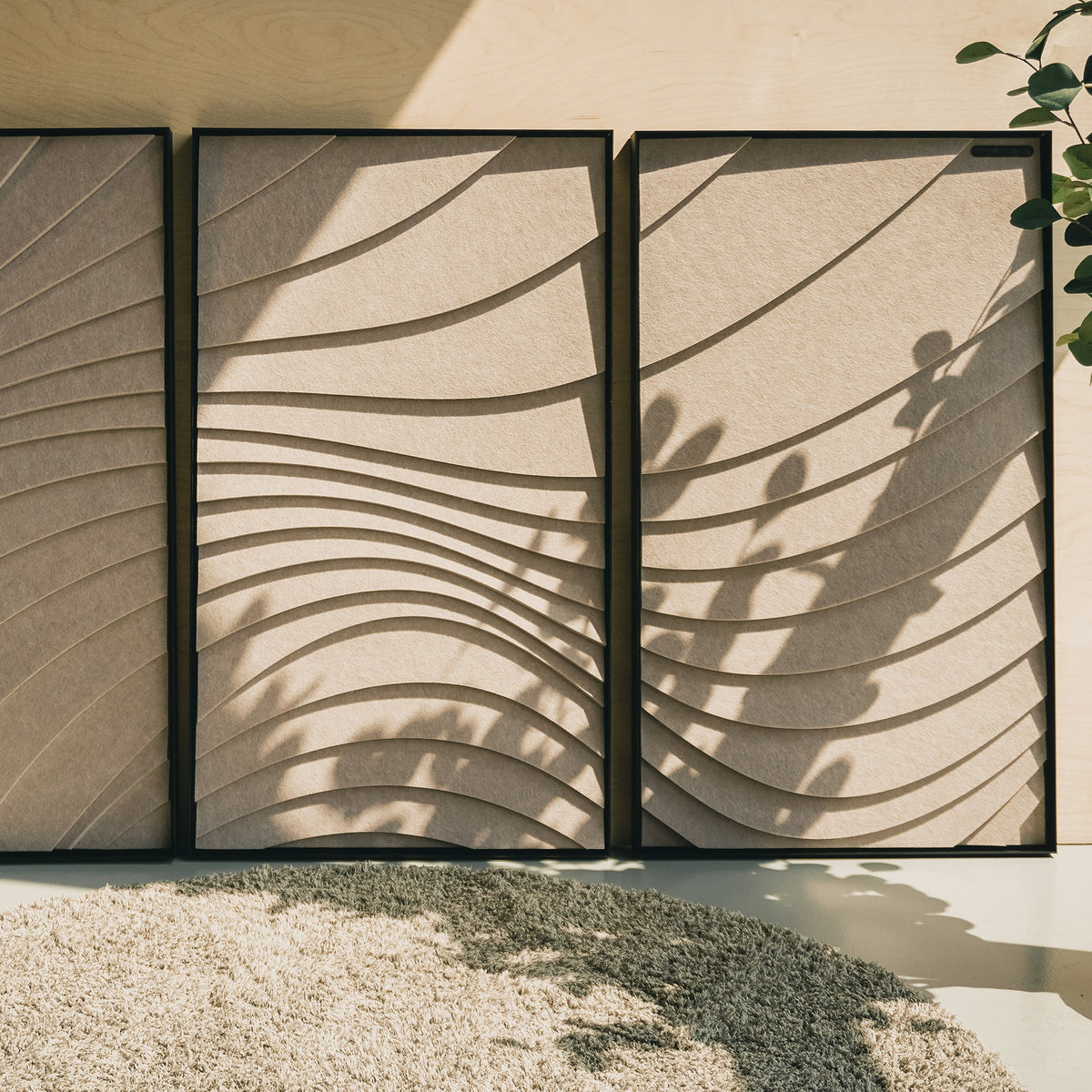
Wall art absorbs sound only when the art itself is the absorber. A framed canvas or a poster under glass has a closed face, so it sends most of the voice range back into the room, as the wall behind it would. A printed acoustic panel absorbs through its flat fabric front. On sculpted felt, the face you see is the absorber, and its relief puts more felt in the sound's way. Above a sofa, a three-panel Massform set takes 1700 to 1800 mm of wall (about 67 to 71 in) and stands 950 mm (about 37.4 in) high.
A canvas print is very good at being a picture. Acoustically, it is more wall.
Does wall art absorb sound?
Acoustically, wall art comes in three kinds.
- Canvas prints and framed posters. Sound cannot get into a closed face, so most of it bounces off. A print changes how a wall looks, not how it sounds.
- Printed acoustic panels. A standard absorber with a picture on it: a flat core wrapped in printed fabric. On a typical one the edges are wood under the fabric, so the front is the only surface that absorbs.
- Sculpted felt. On a Massform set there is no fabric cover. The face is dense polyester acoustic felt, and the felt is what absorbs. Felt holds a shape, so the sides of every ridge, step and groove face the room too.

Acoustic panels that look like art: each set, and how we know
Every Massform art set is three panels of 950 x 550 mm. Beside each is its NRC, one number for how much sound a surface absorbs across the voice range. A figure above 1 is a normal result of the reverberation-room test behind NRC, because sound also reaches a panel's edges. Where there are two numbers, the first is the set alone, the second with a Basstrap behind each panel. "Lab-tested" means an independent laboratory measured it to ASTM C423-22: National Taiwan Ocean University tested Wave, and National Taiwan University a mixed assembly of 18 Art Series panels mounted directly on the surface. "Estimated" means the figure is not a test of that set, and we say where it comes from.
- Wave, in Sandstone or Silver Nimbus: the movement of water, sculpted in felt. NRC 0.95 without / 1.15 with Basstrap, both lab-tested at National Taiwan Ocean University.
- Thresholds (arches and endlessly repeating patterns), Sonic Flow (spiraling ramps and flowing facades), Modular Systems (stacked units, structure on the outside), Glen Canyon (river-cut contours) and Grand Canyon (stepped layers of rock) carry the Art Series pair.
- The Art Series pair: NRC 0.80 without / 1.00 with Basstrap. The 0.80 is lab-tested; the 1.00 is estimated, a calculation rather than a test.
- Color Field: soft blocks of layered felt in the spirit of color-field painting. NRC 1.15 without / 1.25 with Basstrap, both estimated, carried over from Massform's figures for the Basstrap panel.
- Moogdulation: a modular synthesizer in sculpted felt, patch cables included. NRC 1.15, estimated: it has no measurement of its own and borrows Color Field's figure. It belongs to the Basstrap's construction family, so it takes none behind it.

Of any absorption number, ours included, ask three things: what was tested, where, and mounted how. The Compare page sets the curves side by side, and the full range is in the Art Series collection.
Do 3D acoustic panels work?
When the shape is made of the absorber, yes: it puts more felt where sound can reach it. Massform says sculptural rather than 3D; the question is the same, and the useful answer is about surface area.
We measured it from our 3D models: for each square meter of wall a panel covers, how much felt has an open path to the room.
- A typical flat, fabric-wrapped panel: 1.0 m², the front only.
- Surge Pro: 1.75 m². Its lifted layers expose about 70% more felt.
- Cymbals Pro: 3.7 m². The tilted discs expose faces, edges and undersides: more than three and a half times the felt.
- Rhythm Pro: 4.5 to 5.2 m², by slat pattern. Sound reaches both sides of every slat: more than four times the felt.

Surface is not absorption, though. A flat 50 mm panel already absorbs nearly everything in the highs, so the extra felt counts most in the mids. The measured figures are the ones to compare.
Surge Pro is NRC 0.95 without / 1.15 with Basstrap, from the same National Taiwan Ocean University test. Rhythm Pro is 0.85 / 1.00 and Cymbals Pro 1.35 / 1.50, measured in Massform's own room with REW and calibrated against that lab test, their Basstrap figures calculated rather than measured. We have not counted the surface of the art sets yet.
Large wall art above a sofa: what size is a three-panel set?
A finished set takes 1700 to 1800 mm of wall (about 67 to 71 in), depending on gaps of 25 to 75 mm (about 1 to 3 in), and stands 950 mm high.

- Measure the sofa first. Art over a sofa looks settled when it is a little narrower, so the sofa frames it. If the two are close in width, keep the gaps tight.
- Center it on the sofa, not the wall. The sofa is what your eye reads it against.
- Hang it close. High enough that nobody leaning back touches the felt, low enough that set and sofa read as one group.
- Choose the gap for the look. Tight gaps read as one piece; wide gaps read as three.

Each panel hangs from a hook on its top rail, on screws and drywall anchors or from a picture rail, both shown in the installation guide on each Art Series product page. Before you drill, draw the room in Plan in 3D, put the sofa where it really is, and drag a set above it.
Acoustic wall art for a living room: what it does to the echo
Picture a sofa along the long wall, a TV opposite, a wood floor and a large window. Voices bounce between the hard surfaces and the room rings. A set above the sofa absorbs what would have bounced off that part of the wall; whether one set is enough depends on the size of the room and how hard its other surfaces are.

In Hear your room, the example living room takes four Wave sets to bring its echo time in the voice range from about 1.7 seconds to about 0.7. That is an estimate from a model, not a measurement of your room. We checked the model in our own studio: from the empty room as measured, it predicted the room with panels within 8% in every octave from 250 Hz to 4 kHz. Enter your own room and the page says how many sets it needs, then plays it before and after. The realistic plan: one set as the centerpiece, then more on other walls if the room needs them.
What acoustic wall art cannot do
- Block noise. Panels absorb sound already in the room; they do not stop it coming through a wall. Keeping a neighbor's noise out is construction: seal the gaps, add mass. Felt on your side of the wall will make your room sound better while you listen to the drummer next door. Absorption and soundproofing, explained.
- Deep bass. Below about 150 Hz these panels do little, even with a Basstrap: National Taiwan Ocean University measured Wave at 0.08 at 125 Hz alone and 0.25 with one. What the Basstrap does is pull strong absorption lower: with it, Wave's absorption coefficient reaches 1.0 at 200 Hz instead of 500 Hz. The deepest bass needs real depth, usually in the corners.
Estimated rather than tested: Color Field, Moogdulation, and the Art Series with a Basstrap. Each of those figures is labeled where it appears.
Are acoustic panels still in style?
Panels date when they look like equipment: gray squares bought for a number and put up with. Art dates only when you stop wanting to look at it. So choose a shape you will still want to see long after you have stopped thinking about the echo. Relief also changes as the light moves across it during the day. On sculpted felt the shape is the absorber, so the look and the absorption are one decision, not a trade.

FAQ
Do acoustic art panels actually work, or are they just decoration?
They work when the art is the absorbing material: printed fabric through its front, sculpted felt through its whole exposed face. A canvas print does not. Ask how any figure was obtained; more in Do acoustic panels work?
What size wall art should go above a sofa?
A little narrower than the sofa, centered on it. A Massform set is 1700 to 1800 mm wide (about 67 to 71 in): measure your sofa and compare, or try it in Plan in 3D.
How many acoustic art panels does a living room need?
It depends on the room's size and surfaces. Hear your room's example living room needs four Wave sets, by estimate; enter your own room for your number.


Share:
Why Is My Living Room So Echoey, and How Do I Fix It?